Indigenizing Earth Knowledges: Rising from the Ashes

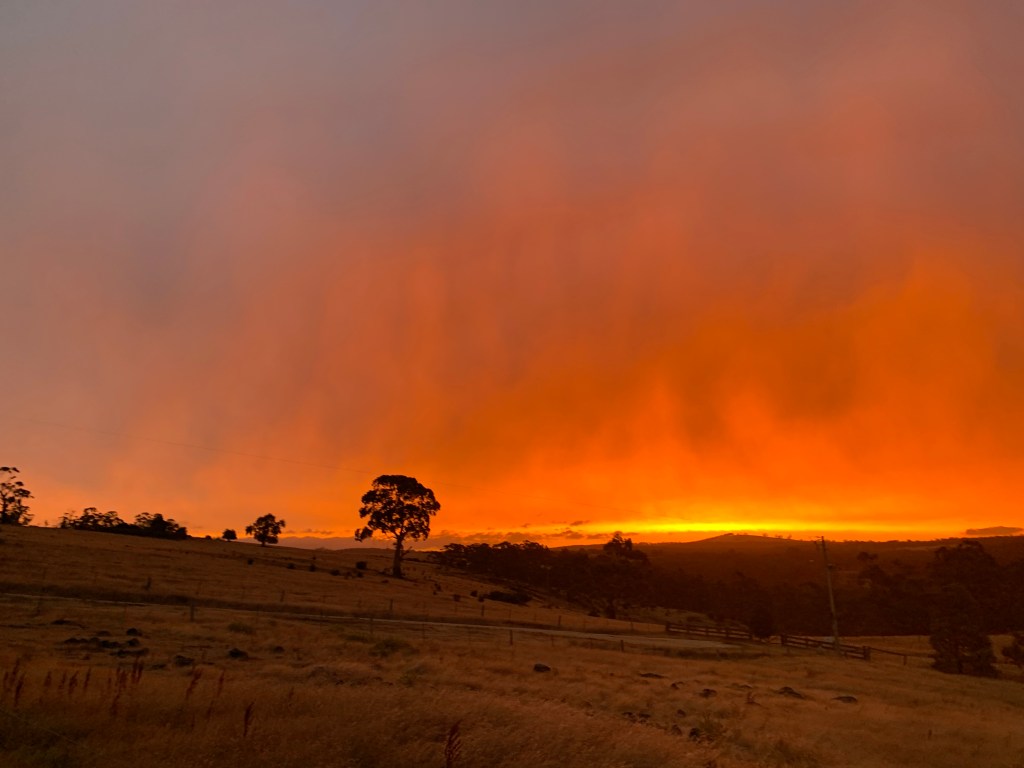
Image: View from my backdoor, 5th January 2020 Country Victoria.  Photograph by Author

Is it possible to build an alliance between contemporary Western thought and Indigenous philosophies which acknowledges the histories and legacies of colonisation by western academy and does not seek to appropriate or co-opt the ancestral philosophical terrain already occupied by Indigenous epistemologies?

This blog touches on many questions and is only a starting point for some discussions on how we can consider a philosophical alliance between the new humanities (posthumanism) and indigenous philosophies.

I recognise I am thinking through the significant contribution of Indigenous Feminist Scholar Zoe Todd (2015, 2016), and others (Szerszynski, 2017 and Adams, 2021) who have presented a clarion call to ‘decolonize’ and ‘indigenize’ the Anthropocene by arguing current posthuman conceptualisations offered to explore the Anthropocene are not enough. Adams (2021) argues for example: “Anthropocene narratives must incorporate deeper colonial histories and their legacies; that related research must pay greater attention to reciprocity and relatedness” and there potential to open up the Anthropocene imaginary “a radical material and relational ontology, purposefully drawing on an Indigenous Knowledge framework to challenge and extend dominant conceptualisations of the Anthropocene within a posthuman and more-than-human intellectual context (p. 283).

I consider also in my thinking the questions raised by Bignall and Rigney (2019) in their chapter in the book, ‘Posthuman Ecologies’: Are we at risk of excluding the ancient philosophical terrain of Indigenous ontologies and epistemologies by claiming western philosophy has found a “new humanities”?

Voices Rising from the Ashes

Starting in November 2019 for a period of four months Australia was ravaged by devastating bushfires. Due to its intensity, size, duration, and uncontrollable dimensions, it was named a megafire. Fuelled by record-breaking temperatures and severe drought these massive bushfires killed over 3 billion animals, burnt over 26 million acres, dozens of humans perished, and buildings were destroying.

Amid the chaos and destruction of the Black Summer fires, polarizing debates dominated the media landscape, with many attributing the disaster to climate change. At the time, the Australian Deputy Prime Minister vehemently criticized those who dared to connect climate change with the escalating bushfire seasons, labelling them as ‘raving inner-city lunatics’ and ‘greenies.’  In response, the Chief Executive of the National Bushfire and Natural Hazards Research Centre emphasized the urgency of addressing climate change, advocating for a significant shift in our perspective. Fire authorities acknowledged their efforts to prepare for fires but recognized that climate change had rendered their conventional practices ineffective.

During this tumultuous period, Indigenous First Nation Traditional owners from across the nation called attention to the need to revisit Aboriginal cultural burning practices, emphasizing the importance of acknowledging the changes in the land and weather since colonisation. They offered to share their ancestral fire knowledge with farmers, scientists, and the broader public.

Adrian Brown, a Ngunnawal murringe (man), asserted in a public statement, “The Australian public should know that they are in an Aboriginal landscape. Our knowledge has been maintained and hasn’t been totally obliterated” (Brown, 2021, p. 29).

This call resonated with many farmers who expressed their desire to incorporate cultural burning into their current land management practices. This willingness to embrace Indigenous knowledges has been seen throughout Australia and overseas not just about cultural fire burning but as significant attention being paid by Non-Indigenous people to “the knowledge and experience of Indigenous people in relation to climate change and associated harms” but alongside this interest there has also been increased and trepidation from Indigenous and First nation people of “the dangers of misappropriation” (Adams, 2021, p. 284) and a lack of deep knowing and reverence associated with practices such as cultural burning due to its connections to, “matters of respect, obligation and responsibility with ancestral lands, waters, skies and everything in between”

But as public debate continued it shifted from not just the lack of understanding of Indigenous ancestral relations but also that in the rush to embrace Indigenous knowledges many non-indigenous Australia’s failed to recognise the raw wounds surfacing about the impact of colonial histories on Indigenous knowledges and connections to country. This included the historical and ongoing violence against these communities who had fought to maintain their connection to their ancestral lands and traditions. Incorporating Indigenous knowledge into Western systems without recognizing this history, no matter how well-intentioned, risked a complicity in perpetuating colonial violence.

Indigenous Feminist scholar Zoe Todd (2016) from Simon Fraser University in Canada has underscored the danger of cherry-picking Indigenous knowledge, selectively embracing aspects that appeal to non-Indigenous scholars, scientists, and the general public, all while sidestepping critical engagement with the political context and legacies of colonialism.

Fletcher and colleagues articulated in their paper on reframing science in light of Indigenous fire knowledge, with an emerging question: “Could Western science in the face of the fire fulfill its mandate by challenging existing paradigms and seeking alternative viewpoints and understandings rather than simply confirming its own biases?”

A viewpoint where we have seen Western scientific views of the Anthropocene, which have tended to denote ‘a universal human’ (who is non-indigenous) ‘and a ‘falsely unified’ and ‘Eurocentric story of the Earth’s transformation’ – which does not include the story of colonisation.  

By exploring the story of cultural burning and other Indigenous knowledges three key commonalities have emerged between the “New Humanities” (posthumanism) and Indigenous Knowledges where I believe some space for alliances can be nurtured:

The first potential space for an alliance is by refusing human exceptionalism and anthropocentrism

Conceptually human exceptionalism and anthropocentric thinking do not support Indigenous and First Nation ways of being in the world which are situated outside of anthropocentricism (Malone and Moore, 2019).  Indigenous philosophies recognize that humans are intertwined with the natural world. Take cultural burning practices for example, considering different seasons on a changing country, movement of animals through landscapes, subtle weather shifts, lifecycles of plants and wildlife, even down to intricacies of the time of day the burning takes place according to the sea breezes from distant oceans, reveal the entangled and deep knowing of country needed when responding to fires.

Western thinking on the otherhand is based on “Human Exceptionalism and treats earth and humans as entirely distinct realms, it considers humans as being(s) outside and/or above (exempt from) any ecological considerations” (Smith 2013, p. 24).  Posthumanist thought, a driving force in the New Humanities, likened to Indigenous ways of thinking challenges this separation, arguing we need refuse to support these the dividing lines between humans and the rest of the world (Malone et al, 2020).

The new humanities through posthumanism demands an ‘unlearning’ of anthropocentric ways of being and knowing the world, it demands a disruption of the universal human story of anthropocentrism, dismantle human exceptionalism and consider beyond the human and the more-than-human are interdependent (Kopnina et. al 2018). While there is some congruence here between Indigenous approaches and this shift in the new humanities philosophies– the difference is Indigenous approaches were never anthropocentric therefore there is no need for unlearning.

The second potential space for an alliance is by embracing a vitalist ethics of human responsibility towards all life-forms

Vitalism, as a foundational concept in Indigenous thinking, permeates all living beings, fostering an ethical imperative grounded in care, creativity, and reciprocity with both living and non-living entities. When refusing human exceptionalism and anthropocentric thinking we open spaces to where a vitalist ethics of human responsibility towards all life-forms can thrive and potentially embrace an ethics of shared responsibility (Bignall and Rigney, 2019).

While there is no one way to reflect the diversity of global Indigenous and First nation philosophies, but one common aspect seems to be a ‘vitalist’ ethics and respect shared across creation and the cosmos.  In contrast, Western science has often demonized vitalist life forms. For instance, fighting fires is likened to being at war with nature, controlling it managing destroying it, this contrasts starkly with Indigenous traditions that revere it as a beautiful, comforting entity with its own spirit and energy. For example, Carol Pettersen, a wise woman from the Noongar Nation, shared, “Fire is a beautiful, warm, comforting entity. It’s got a spirit of its own, and we see that and the energy within, and we respect it” (Pettersen 2021, p. 9).

At the core of these understandings is an intimate understanding of the symbiotic relations between scale, time, place and beings, an onto-epistemology of fire burning as cultural and ecological practice evolved over thousands of years. Reciprocity, according to Fletcher. et. al (2021) is central to the Australian Indigenous peoples and their relationship with County something Eurocentric land management paradigms has little sympathy for.

This Indigenous relationship is one in which the health of people is linked to the health of the world around them (Country), an epistemology that obliges people to “care for Country”. This reciprocity is fundamental to the health, lives and livelihoods of Indigenous Australians, and reconnecting people to places through the lens of natural resource management has had significant and widespread social and cultural benefits (Fletcher. et. al. 2021, p. 4-5)

This perspective exemplifies the vitalist ethics deeply rooted in Indigenous philosophies.

The third potential space for an alliance is by engaging relational ontologies and acknowledge our shared ecological interconnectedness

The bushfires in Australia not only claimed human lives but also devastated wildlife, with over 60,000 koalas estimated to have perished. The bushfires prompted discussions about relationships between climate change, rising temperatures, drought, logging, farming, back burning practices, and land management. Absent trees, animals, earth and waters acknowledge only in their passing.

Aunty Eileen Alberts a Gilgar Gunditj Elder, Gunditjmara Nation describes the deep connection between the burning of puunygort, Carex tereticaulis grass to enhance fresh growth and its use by her grandmother to weave eel baskets, to catch eels on the lava fields of her ancestors.

“Men’s only job with the puunygort was to burn and only when asked by women. Everything else connected with the grass was women’s work. As a child I watched Pop supervise his sons and brothers, so they did a cool cultural burn of the puunygort” (Aunty Eileen’s story, Albert, 2021, p. 16).

Aunty Eileen also tells of an ancient tradition almost lost when woman including her Aunty Connie Hart were rounded up, placed in missions, and told if they taught cultural things their children would be taken away. “It took a long time for us to convince her to teach us because of that threat of your children being taken away” (Aunty Eileen’s story, Albert, 2021, p. 16).  Indigenous philosophies and traditions as expressed in these stories of cultural burning, illustrate thousands of years of ancestral and spiritual connection to ecologies, deliberately silenced by western environmental thinking.

It is this relational complexity attached at the spiritual, ancestral and physical where colonisation and past legacies need to be honoured.  Yet in a desire for non-indigenous people to adopt Indigenous practices without acknowledging the uncomfortable colonial histories or the complexities of fire relations in Aboriginal traditions, there was a risk we were repeating these acts of colonisation. In a background paper written by traditional owners during the Royal Commission they state “Indigenous Australians had employed fire for land management for over 60,000 years, but these practices had been disrupted over generations. While there was growing recognition of the value of cultural burning in mitigating the effects of bushfires, Traditional Owners had concerns about whether those without a cultural connection to the land could exercise the necessary care and responsibility” (Victorian Traditional Owners, 2021, np).

The Victorian Traditional Owner Cultural Fire Strategy written by the Victorian Traditional Owners (2021, np) included six guiding principles: “cultural burning is right fire, right time, right way and for the right (cultural reasons), according to lore; burning is a cultural responsibility; cultural fire is living knowledge; monitoring, evaluation and research support cultural fire objectives and enable adaptive learning; Country is managed holistically, and cultural fire is healing”.

Understanding cultural burning requires acknowledging it as an Aboriginal tradition deeply rooted in ancestral connections between people and country. That is, cultural burning or cultural land management cannot just be added to the existing non-Aboriginal practices currently being used by the western land managers.

While a ‘New Humanities’ approach such as posthumanism purports to embrace a relational ontology, by acknowledging the complexity of human connectedness to the natural world and by rejecting anthropocentrism, both issues at the heart of Indigenous conceptualisations, it is a very recent intellectual and political response with a short historical lineage. As a rejection of western cultural imperialism,  posthumanism has been critical of the way ‘nature’ has been construed, subjugated, and exploited but mostly this is limited within the modernist era. Bignall and Rigney, (2019, p.167) argue, “posthumanism has tended to criticise and reconceive ‘humanity’ and ‘nature’ mainly as these appear as cultural constructs of the West, with the (unintended) consequence that alternative, non-Western concepts of human being are frequently eclipsed”.  And while posthumanism is critical of western thinking, Eurocentric whiteness, settler colonialism and androcentrism it is still clearly located as a strain (albeit critical) within western academy (Bignall and Rigney, 2019). Posthumanism does not have spiritual or cosmological soul. It is a theory of the mind.

To build a meaningful alliance between contemporary Western thought and Indigenous philosophy, it is crucial to engage with specific Indigenous ontologies, respecting their diversity and locality. This alliance must recognize the risks faced by Indigenous people as they coexist within a dominant colonising tradition that has systematically excluded Indigenous knowledge and disrupted their relationships with the land through centuries of violent colonial practices.  The New Humanities and the Posthuman therefore need to navigate this complex terrain with sensitivity and humility, fully acknowledging the unique contributions Indigenous knowledges has in responding to the challenges of the Anthropocene, while also realising as non-indigenous scholars we are deeply stepped in the histories of the western academy and change must come also from dismantling our own house.

On September 22, 2023 I was invited by Unity Earth to provide a short presentation around the topic of this blog and engage in a conversation with Chief Phil Lane Jnr and Ben Bowler on Indigenizing Earth Knowledges. You can connect to a recording of this event below:

References

Adams, M. (2021) Indigenizing the Anthropocene? Specifying and situating multi-species encounters, International Journal of Sociology and Social Place, 41 (3/4), p. 282-297. 

Albert, E. (2021) Aunty Eileen Albert’s story, in Weir, J., Freeman, D., and Williamson, B. (Eds) Cultural Burning in Southern Australia, Report No. 687.2021, Bushfire and natural Hazards CRC, Melbourne.

Bignall, S.  and Rigney, D. (2019) Indigeneity, Posthumanism and Nomad Thought Transforming Colonial Ecologies, in Braidotti, R, and Bignall, S. (eds) Posthuman Ecologies. Rowman & Littlefield.

Brown, A. (2021).  Adrian Brown’s Story, in Weir, J., Freeman, D., and Williamson, B. (Eds) Cultural Burning in Southern Australia, Report No. 687.2021, Bushfire and natural Hazards CRC, Melbourne.

Fletcher, M., Romano, A., Connor, S., Mariani, M., and Maezumi, S. (2021). Catastrophic Bushfires, Indigenous Fire Knowledge and Reframing Science in Southeast Australia, Fire 4,(3), 61. https://doi.org/10.3390/fire4030061

Kopnina, H,. Haydn Washington, H., Taylor, B., and Piccolo, J. (2018) Anthropocentrism: More than Just a Misunderstood Problem, Journal of Agricultural Environmental Ethics, 31, 109–127

Malone, K., Logan, M., Siegel, L., Regalado, J., & Wade-Leeuwen, B. (2020). Shimmering with Deborah Rose: Posthuman theory-making with feminist ecophilosophers and social ecologists. Australian Journal of Environmental Education, 36, 129–145.

Malone, K., and Moore, S.J., (2019). Sensing Ecologically through Kin and Stones, International Journal of Early Childhood Environmental Education, 7(1), p. 8-25.

Pettersen, C. (2021). Carol Petersen’s Story, in Weir, J., Freeman, D., and Williamson, B. (Eds) Cultural Burning in Southern Australia, Report No. 687.2021, Bushfire and natural Hazards CRC, Melbourne.

Smith, M. (2013). Ecological community, the sense of the world, and senseless extinction. Environmental Humanities, 2, 21–41. Retrieved from http://environmentalhumanities.org

Szerszynski, B. (2017), “Gods of the anthropocene: geo-spiritual formations in the Earth’s new epoch”, Theory, Culture & Society, Vol. 34 Nos 2-3, pp. 253-275.

Todd, Z. (2015), “Indigenizing the Anthropocene”, in Davis, H. and Turpin, E. (Eds), Art in the Anthropocene: Encounters Among Aesthetics, Politics, Environments and Epistemologies, Open Humanities Press, London, pp. 241-254.

Todd, Z. (2016), “An Indigenous feminist’s take on the ontological turn: ‘Ontology’ is just another word for colonialism”, Journal of Historical Sociology, Vol. 29 No. 1, pp. 4-22.

Victorian Traditional Owners, (2021). The Victorian Traditional Owner Cultural Fire Strategy 

Acknowledgement

The author would like to acknowledge the Traditional Custodians of the unceded lands where she writes and lives, the Boonwurrung People of the Kulin Nation.  She would like to celebrate the diversity of all Aboriginal and Torres Strait Islander peoples and their ongoing cultures and connections to the lands, animals, and waters of their Country and supports the path to reconciliation and embracing the Uluru Statement of the Heart.

The author acknowledges Aboriginal knowledges of cultural fire burning practices are place specific and supported by the unique ancestral traditions related to the health and well-being of all entities on Country. This paper focuses on Aboriginal cultural fires practices in South-West Australia, the site of some of largest and most destructive Black Summer fires.

The author would like to acknowledge specifically the invaluable stories of cultural burning provided by Carol Pettersen Minung/Gnudju kayang, wise woman, Noongar Nation; Aunt Eileen Alberts Gilgar Gunditj Elder, Gunditjmara Nation; Adrian Brown Ngunnawal murringe man; and Jason Andrew Smith Palawa man, cultural burning educator and fire practitioner. Theirs and other Aboriginal stories of cultural burning are available in full in the report Cultural Burning in Southern Australia published by the Bushfire and Natural Hazards CRC, Melbourne and downloaded here:  www.bnhcrc.com.au/driving-change/indigenous-initiatives

This blog is an extract of a provocation given to start a conversation between Chief Phil Lane Jnr, Ben Bowler and myself as part of Peace Week supported by Unity Earth. The presentation recording is available here https://unity.earth/tv/
Validating children’s feelings of loss when the planet they love and care for is dying

We need to look after our planet or otherwise, otherwise it will die.

Like koalas, animals, us. Us we will die.

Animals will die. Everyone will die.

I know everything is dying. I know every plant will die.

– Elke, aged 4 years old.

United Nations projections reveal that rather than falling below the internationally agreed limit 1.5C by 2030, the cut needed to keep a lid on increase the climate crisis, carbon emissions around the world are expected to rise by 16% in that time. At the same time according to a number of recent reports including the latest World Health Organisation, climate change is a major determinant of human health and the most significant environmental stressor experienced by all earth dwellers, humans and non-humans alike. For children the impact of the climate crisis on their health and well-bring is two-fold. Firstly, due to their fears and anxiety about the climate crisis it has emotional and psychological impacts on their well-being, and secondly, with increased air pollution, heat waves, poor water quality, floods, food shortage and greater exposure to toxins it has scientifically proven impacts on their physical bodies and ongoing health.  Given the projected acceleration of climate change in the next 50 years, it is likely this prevalence and the severity of emotional responses such as fear, grief and anxiety and health impacts will continue to increase substantially.

Children’s concerns about the future of the planet

I am troubling traditional climate change education by disrupting psychological terms, such as ecophobia and ecoanxiety which have been used in the literature to describe children’s concerns and grief about the state of the planet.  In an article about her research on children’s environmental concerns in Denver USA, for example, Susan Strife (2012) found over 80% of children were concerned about the destruction of nature, global warming, air pollution and the way humans were killing animals.  She highlighted a number of the children’s responses in her article and argued they represented children’s sense of pessimism, anger, helplessness, and frustration.

“I feel sad because the animals are going to die. (Jennifer, age 10).

Something is going to happen in the world, and everything is going to get destroyed. (Lucia, age 10).

I had dreams of people crawling out of these smoke filled environments coughing, and that really scared me…(Riley, age 10)

I know that I am a little too young to help right now, so I feel helpless not being able to do anything. (Cliff, aged 10)” (Strife, 2012: 43)

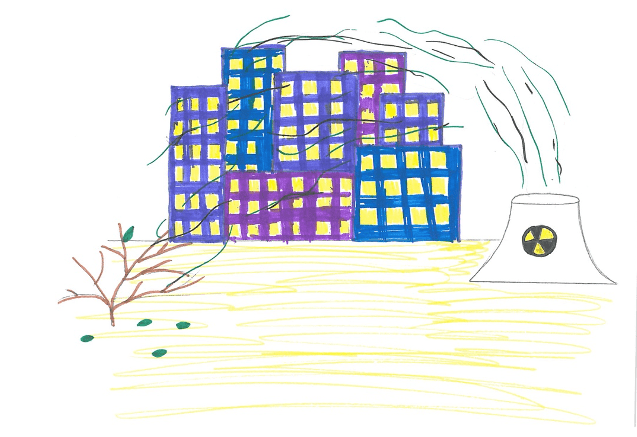
These concerns were further exacerbated when she asked children to draw the Earth in a 100 years’ time. The drawings revealed a common theme of doom and gloom; the world would end and animals including humans would die. Drawing on the work of David Sobel (1993, 2008) she argued children were not developmentally or emotionally able to cope with the distancing and abstraction of environment-related disasters shown on television programs or doom and gloom education; and these were adding to children’s feelings of environmental concern. She supported Sobel’s (1993) view children were experiencing ‘ecophobia’ and to counter this, the focus of science and environmental education should be on age-appropriate scientific learning and environmental actions at the local-level rather than global or earth-based knowledges.

With the impact of the climate crisis now penetrating all facets of our lives, most humans believe climate change will cause major devastation in the future with the belief the quality of life they are currently experiencing will be impossible to sustain for future generations. Research studies, for example, are revealing particularly for children, the current climate crisis conjures up emotions of dread, feelings of denial and fear for themselves, their families and for ‘other’ beings we share the planet with. We are in a physical crisis and a crisis of the imagination.

Fear in this context evokes in children as it does in most animals a flight or fight response. It is often assumed ‘fear’ can lead to action yet as O’Neill and Nicholson-Coles (2009, 374-375) reveal while “fearful representation of climate change appears to be memorable and may initially attract individual action” but “due to the enormity of the problem the opposite effect can happen – it can evoke a distancing and disempowerment”. Overwhelming fear without hope can induce strong feelings of anxiety which may lead to action but more likely its leads to paralysis even denial (ecologist name this as the ‘great turning away’, when feelings of despair, no hope, no way forward lead to ignoring or pretending the devastation isnt happening ).

Children’s environmental concerns are not new, research over decades has shown they are particularly attuned to the ambiguities of science heroism and extractive models of ecological destruction as taught in traditional science education and how these fashion feelings of confusion and despair about the future. In the past, this confusion or despair was identified as ecophobia or children’s fear of the environment (Sobel 2008) in recent times this emotional response is now being labelled as climate or eco-anxiety.

Asking children to fix the problem is not the answer.

Two years ago the results of a large-scale health study on children and young people’s climate anxiety was released by Catherine Hickman and colleagues from the University Bath. Surveying ten thousand young people aged between 16-22 years from ten countries, Australia, Brazil, Britain, Finland, France, India, Nigeria, Philippines, UK, USA. Countries were chosen to reflect populations from different countries, representing a range of cultures, incomes, climates, climate vulnerabilities, and exposure to differing intensities of climate-related events.  Hickman et. al’s (2021) research is by far the largest global study ever capturing children’s concerns about the planet that also includes the scale, extent and impact of adult’s climate inaction on children’s climate (eco) anxiety.

Hickman et. al’s. (2021) study focused on young people’s emotions by using the term climate anxiety to encapsulate a host of responses by young people when asked questions such as were they worried about climate change and did that worry impact on their functioning; whether they thought humanity was doomed; or if people had failed to take care of the planet; and the role of governments could they be trusted, did they take the crisis serious enough?

The study was seeking to understand children’s psychological responses and manifestations to climate crisis including identifying trauma and shock; stress, anxiety; depression; substance abuse; loss of autonomy; feelings of helplessness, fatalism, and fear.  The results of the extensive survey revealed not only the disturbing scale of emotional effects of the climate crisis on children including high levels of fear, grief, anxiety, stress, powerlessness, but also the impact of adult betrayal on young people’s anxiety. Hickman et. al.  reported: “Respondents rated governmental responses to climate change negatively and reported greater feelings of betrayal than of reassurance. Climate anxiety and distress were correlated with perceived inadequate government response and associated feelings of betrayal”. Hickman et. al (2021) in contrast to Strife (2012) and Sobel (2008) argued education focusing on local environmental actions aren’t the solution to young people’s concern and eco-anxiety, instead what needed to be addressed was the impacts of adult’s inaction.

“Thinking the way to cure eco-anxiety is eco-action isnt right” it is a “simplified solution that doesn’t address the real problem – the need for governments to act urgently” (Hickman et. al. 2021.  They questioned why should children and young people take responsibility and carry the burden. Hickman and her colleagues suggest if we wanted to protect the health and wellbeing of young people, those in power should be “reducing young people’s stress and distress by recognising, understanding, and validating their fears and pain, acknowledging their rights, and placing them at the centre of policy making”. (Hickman et. al. 2021). “Before we can offer the younger generations a message of hope, we must first acknowledge the obstacles that must be overcome” and “the failure of governments to adequately reduce, prevent, or mitigate climate change is contributing to psychological distress, moral injury, and injustice” (Hickman et. al 2021, 871).  Asking children to fix the problem is not the answer. Neither is seeing eco-anxiety as a child’s problem.

Anxiety is caused by caring for the planet

Hickman et. al. support the view children and young people’s feel anxiety because they are: “caring for the planet” (Hickman et. al 2021). They go on to claim, what children feel is a moral, ethical position not a psychological one. Hickman et. al (2021) call it ‘moral injury’ and explains: “Moral injury … is a sign that one’s conscience is alive”. For children, they argue, “it inflicts considerable hurt and wounding when they see adults including governments are transgressing fundamental moral beliefs about care, compassion, planetary health, and ecological belonging” (Hickman et. al 2021, 871).  Hickman et. al (2021) advises educators if children asks hard questions about the future or share their worries we can respond by saying they should feel proud of having such feelings: “Because feeling anxiety or worry is about caring for the planet”.

Reciprocity and responsibility are the basis for Earth relations in many Indigenous and First Nation communities and is understood as a mutual obligation to adhere to ethical relations.   Ethical kin relations means also expressing ‘care’ for the Earth including land, sea, waterways, animals, plants and all that makes up the cosmos.  Joanna Macy (1995) has told us feeling pain within the enormity of a global crisis is natural and healthy, she argues we/children feel pain and anxiety because, as compassionate entities deeply interconnected with the Earth, we/they care.   “The conspiracy of silence concerning our deepest feelings about the future of our species, the degree of numbing, isolation a burnout and cognitive confusion that result from it – all converge to produce a sense of futility. Each act of denial, conscious or unconscious, is an abdication of our powers to respond” (Macy 1983, 16). 

Focusing on Hope and Healing

For many the current state of the world relays an image of precarity and disenchantment, devoid of hope. Bennett (2016) responding to this image of a disenchanted modernity asks not if this is real but, “rather, whether the very characterization of the world as disenchanted ignores and then discourages (or allows) affective attachment to that world” (Bennett, 2016 p. 3). This raises a question about our emotional response to the Earth during this time– to feel hope, enchantment, attachment and care she argues “is important because the mood of enchantment may be valuable for an ethical life”.  “To be enchanted”, according to Bennett (2016 p. 159), “is in the moment of its activation, to assent wholeheartedly to life—not to this or that particular condition or aspect of it but to the experience of living itself”. She argues it is the wonder of minor experiences where the gift of enchantment purchases itself.  I believe it is here in these gestures of love and care; hope and healing can grow.

According to Leslie Head (2016) in her book Hope and Grief in the Anthropocene; “Hope is not an optimistic affect nor a utopian dream, nor a sunny disposition”.  “Hope is practised and performed; it is a sort of hybrid, vernacular collective worked out in everyday practice and experience” (Head, 2016, 90).  Ecofeminist have long argued that emotional responses to the ecological crisis, are missing in many accounts of the world (Head 2016, 22).  Emotions are seen as the anti-thesis of scientific rationality and in climate change debates emotions are often viewed as weak, irrational, childlike, feminine. Yet to nurture hope we need to take emotions more seriously, in the climate crisis while these as emotions can lead to fear, anxiety, even paralysis they can also be the stimulus for higher degrees of motivation, hope, faith, attachment, and potential optimism.   Or as George Monbiot (2014) Environmental campaigner, journalist, writer, reminds us “if you feel at odds with the world, if your identity is troubled and frayed, if you feel lost and ashamed – it could be because you have retained the human values you were supposed to have discarded”.

Hope is important for healing grief and caring and this hope needs to be imagined. In the project Children in the Anthropocene (Malone, 2018) where like Strife (2012) I conducted research with children about their environmental concerns. Unlike Strife (2012) though, rather than asking children to draw what they thought the world would look in 100 years time, I asked children to dream an imaginary future of how they would want it to be.

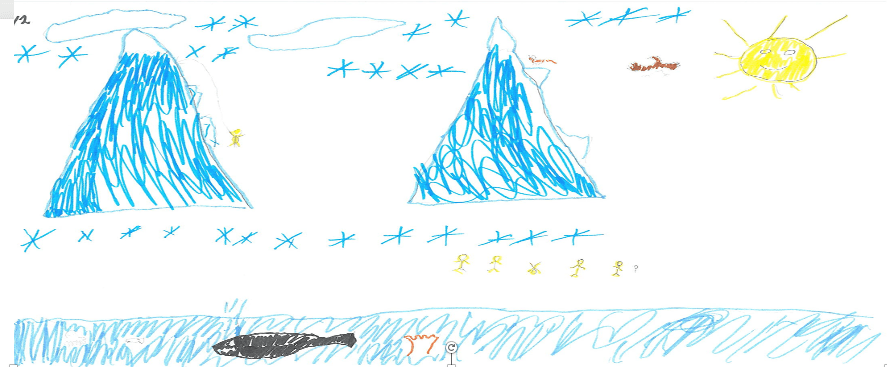
Anna who was 11 years old and came from Semey in Kazakhstan, a city unfortunately notable as the site of where over a period of 40 years city dwellers were exposed to 456 nuclear tests.

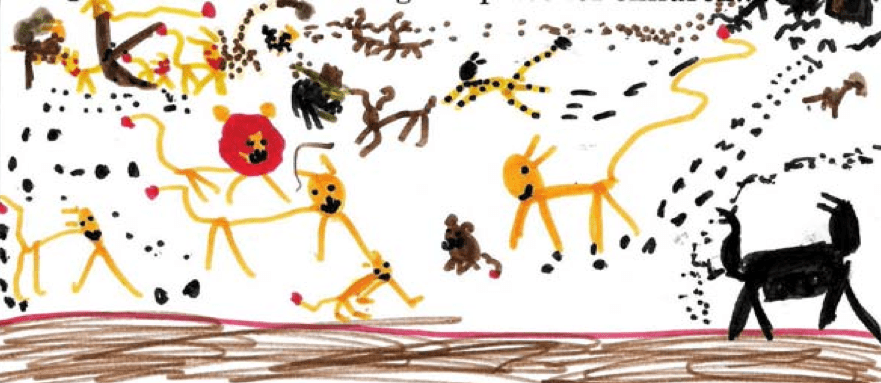
She draws a picture depicting high mountains, blue river with fish and a clear sunny day. She described her dream future world: “This is my dream planet. I love mountains I would want mountains with snow. The snow would stop melting. I love nature and animals. I would like to walk in the mountains with snow and take pictures of healthy animals. I want to swim underwater and see fish. And I would want to dance because of being so happy to be breathing fresh air and there would be no pollution”. 

And Princess, 5 years old who lives in a typical middle-class suburban township in Melbourne Australia draws a picture of a host of seemingly joyful wild animals playing together and describes her drawing this way, “This is my drawing of my dream um for the future. On the planet all children and animals would be free and not die”.

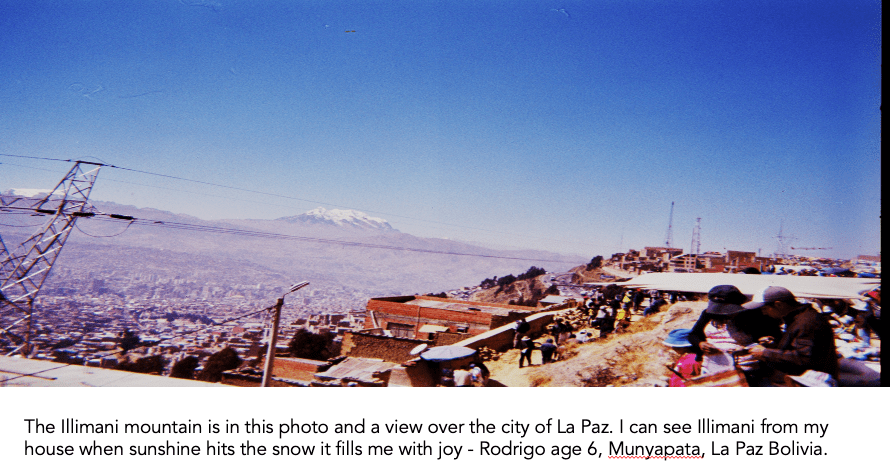
Children who are identified as struggling, having a psychological ‘condition’ such as cliamte or eco-anxiety are mostly viewed as needing help to overcome their symptoms, their problem.  Yet what we urgently need is education where opportunities are available for children to reveal these painful emotions, to be heard by adults who will not dismiss their concerns or climate actions as merely childish or over-emotional, as many of our Politicians have.  We need education to expose truths, bear witness to the profound impacts the crisis is having on children and support them to explore why painful emotions can be paralysing and whether it is possible to utilise these emotions to create hope and healing for children. Can we find ways to respond to their moral injury, to acknowledge their feelings of loss and the mourning of their future lives on a planet that seems so fragile so precarious. To find healing in the wonder and enchantment, even simple moments of joy of being with the Earth (as shown in the photograph by Rodrigo) and come to move towards a mutual belonging where a new kind of power resides, an awakening and validation of the powerful emotions of gratitude, awe, beauty, love, care and compassion. A desire to love the world; to dream of potential better future worlds; to fight for hope and for its shared healing.

References

Bennett, J. (2001). The Enchantment of Modern Life, Princeton University Press, NJ.

Head, L. (2016). Hope and Grief in the Anthropocene, Routledge.  

Hickman, C. Marks, E., Pihkala, P., Clayton, S.  Lewandows, R. E., Mayall, E., Wray, B., Mellor, C., and van Susteren, L. (2021). Climate anxiety in children and young people and their beliefs about government responses to climate change: a global survey, Lancet Planet Health, 5; 863-873.

Macy, J. (1983). Despair and Personal Power in the Nuclear Age, New Society Publishers, PA.

Macy J. (1995). Working through environmental despair. In Roszak T., Gomes M. E., Kanner A. D. (Eds.), Ecopsychology: Restoring the earth, healing the mind (pp. 240–259). San Francisco, CA: Sierra Club Books.

Malone., K. (2018). Children in the Anthropocene: Rethinking Sustainability and Child Friendliness of Cities. Palgrave.

Monbiot, G. (2017). Forget ‘the environment’: we need new words to convey life’s wonders. The Guardian. https://www.theguardian.com/commentisfree/2017/aug/09/forget-the-environment-new-words-lifes-wonders-language.

O’Neill, S., & Nicholson-Cole, S. (2009). “Fear Won’t Do It”: Promoting Positive Engagement With Climate Change Through Visual and Iconic Representations. Science Communication30(3), 355–379.

Sobel, D. (1993). Children’s special places: Exploring the role of forts, dens and bush houses in middle childhood. Tuscon, AZ: Zephyr Press.

Sobel, D. (2008). Childhood and nature: Design principals for educators. York, ME: Stenhouse Publishers.

Strife, S. (2012) Children’s Environmental Concerns: Expressing Ecophobia, The Journal of Environmental Education, 43 (1), 37-54.

Gidyira (kin) and Wren: Children’s Bodies Sensing Ecologically

Professor Karen Malone, Swinburne University of Technology

Dr. Sarah Jane Moore, Independent Creative Artist 

We acknowledge the Aboriginal Countries that Sarah Jane and I work on, learnt on, live on and pass through and we show gratitude to the traditional custodians, the kin and Countries that have guided our research. Sarah Jane Moore’s writing acknowledges the Connecting to Country teachings of Oomera Edwards, Elder and Educator and pays homage to the language teaching of Auntie Iris Reid. The use of Wiradjuri concepts assisted Moore to story deep and ancestral notions of Country and place through the worlding of an Aboriginal child

The breathing, sensing body draws its sustenance and its very substance from the soils, plants, and elements that surround it; it continually contributes itself, in turn, to the air, to the composting earth, to the nourishment of insects and trees and kin, ceaselessly spreading out of itself as well as breathing the world into itself, so that it is very difficult to discern, at any moment, precisely where this living body begins and where it ends

– David Abraham (1996) The Spell of the Sensuous, page 46.

Jean Luc Nancy (1997) acknowledging we are beings-in-common recognises our coexistence in the world with others and Marisol de la Cadena (2015) drawing on her work with Indigenous peoples in the Andes proposes we exist in the world as ‘more than one – but less than many’. This is the starting point the Posthuman child – a disrupting force for troubling child/hood-nature binaries – in this story child is nature, with critters in a worlding becoming as relational possibilities. Humans are tuned for relationship. The eyes, the skin, the tongue, ears, and nostrils—all are gates where our body receives the nourishment of otherness. This landscape of shadowed voices, these feathered bodies and wagging tails and tumbling streams—these breathing shapes are our family, the beings with whom we are engaged, with whom we struggle and suffer and celebrate.

For the largest part of our species’ existence, humans have negotiated relationships with every aspect of the sensuous surroundings, exchanging possibilities with every flapping form, with each textured surface and shivering entity that we happened to focus upon. All could speak, articulating in gesture and whistle and sigh a shifting web of meanings that we felt on our skin or inhaled through our nostrils or focused with our listening ears, and to which we replied—whether with sounds, or through movements, or minute shifts of mood. The color of sky, the rush of waves—every aspect of the earthly sensuous could draw us into a relationship fed with curiosity and spiced with danger. Every sound was a voice, every scrape or blunder was a meeting—with Thunder, with Gum, with Dragonfly. And from all of these relationships our collective sensibilities were nourished – Drawing from and adapting – David Abraham (1996)

In  a modern eurocentric world with in the microcosm of human life we created in our cities we participate almost exclusively with other humans and with our own human-made technologies. It is a precarious situation, given our age-old reciprocity with the complex assemblages of our landscape.

Sympoiesis is how we are naming the shared experience of ‘sensology’. Sympoiesis means making with. It describes the complex relations that produce life, dynamism, responsiveness, situatedness, entanglement, relationality.  Sympoiesis supports a view of humans as interdependent of all ecological beings, objects and weathering of the earth with the concept of ‘ourself’ being determined by a world that lies beyond the illusory borders of our bodies. Bodies are porous and open attributing the qualities of a shared life through sensorial knowing. As we pick and unpick together in dialogue what it means to have a porous body Sarah Jane notes sympoiesis is congruent with Aboriginal ways of encountering and taps into old stories and old ways of seeing spirits, animals and spirits as co-existing. Ingold (2013) reminds us to consider not limiting materiality to the surfaces of the landscape or objects but to acknowledge the centrality of the weather/ing, the air, the atmosphere of the world.

At the time of our research the two children were inbetween 1 and 3 years old.  One child was Aboriginal, Budya which is Wiradjuri for ant.  The other non-Aboriginal child Wren, was named after the  common songbird living with her.  The research drew on a model of posthumanist ecological communities where human and nonhuman are beings in common. It embraced an approach where Country, or the entity that is land was regarded as always in relation with all bodies, even if the knowing body was not attuned to notice these relations . The Aboriginal child, land and story was traced as a being in common with an identity, a past, a present and a future to be listened to, mapped, theorised and imagined. Walking on Country for the Aboriginal child, brings Aboriginal perspectives into engagement and encounters with the social world. In this way postqualitative/posthuman readings of Country acknowledged the presence, the lived space and dynamism of walking with, and in, and of, the land.

We loosely call our research as a place based postqualitative/posthumanist inquiry. Postqualitative/posthuman researchers support that knowledge is based not on unchallengeable truths existing outside of humans and nonhumans but knowing and being is relational – this approach builds on an onto-epistemological view that is all knowing is entwined, entangled with being. We cannot know the world without being in the world, we cannot be in the world without knowing it.  There are a number of methods and approaches that fit within the post-qualitative/posthuman paradigm we adopt, the focus of these practices is to acknowledge the world is not just ‘out there’ waiting to be interpreted, but is ‘in here’,  ‘in us’ ad with ‘us’ us being all the relations that inform our being and knowing of the world. This process of knowing and becoming intimate and attuned to a lively world including weathering worlds is what we call worlding. The children in our study are worlding. Our research methods are acquainted with the process of capturing that worlding. Walking methodologies figure centrally in our study and we take from Aldred (2014) who writes: “To move through a landscape is to dwell in the movement, to experience being with and connected to” (p. 31). Walking as method is central to our shared sense making. Noora Pyyry calls this walking as intra-action ‘a sensorium in action’.  It is through sensorial bodies, bodies sensing and recognising other bodies that sense making is activated.

The three to five-minute video captures have been gathered on mobile phones as Budya  and Wren go about their everyday worlding. Sensing ecologically is a concept we are using in order to imagine how children can engage/communicate with the more-than-human-world prior to human abstract language acquisition. That is, how they (human) come to find ways to be with nonhuman animals; plants; the weather; water; and materials. Embarking on this research there was a need to be attentive to the very subtle encounters nuances and gestures of sensing bodies.

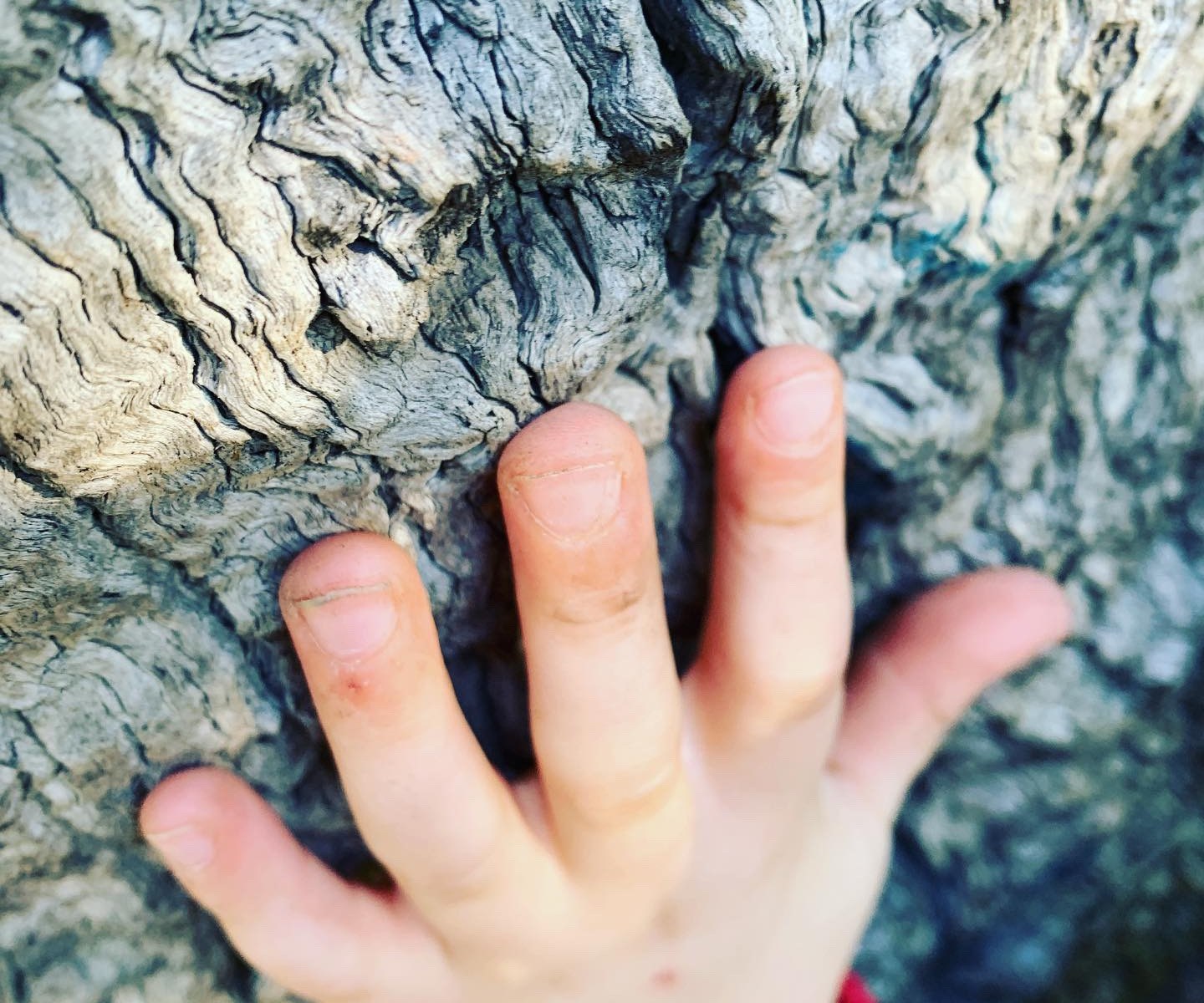
Walking-with and through environments provides opportunities for children to encounter the materiality of spaces, to be with objects, intra-act and co-create sensorial, nature based knowings. Walking-with and through the children’s sensorial body means that we know as we go (Ingold 2010). Living in and being with the world according to Ingold (2013, p. 29) means we encounter “a lifetime of intimate gestural and sensory engagement”.  This thinking supported the children to be storied as sensing bodies and in particular the Aboriginal child to become with the aliveness of Country

The Gudhang (ocean) is our friend

The Madhan (tree) is our partner

The Walang is our tool for thinking.

The Gidyira (kin) is our teacher.

The land is our Gunhi (mother).

The land beneath us is alive (Moore, 2019).

The theoretical framing of this research is supported through a form of diffractive theorising drawing on a relational ontology. Barad (2007) states that while diffraction apparatuses help us: “… measure the effects of difference, even more profoundly they highlight, exhibit and make evident the entangled structure of the changing and contingent ontology of the world, including the ontology of knowing. In fact, diffraction not only brings the reality of entanglements to light, it is itself an entangled phenomenon” (Barad, 2007, p. 73)

As a ‘re-turning’ like composting we are diffracting our data drawing on an emerging ‘posthumanism and vital materialist turn’ that supports a shift in focus, from culture as outside of nature, to a re-orienting of relations where the human and more-than- human world are recognised as existing in an ecologically ‘messy entanglement’.          The research employs the potential of posthumanist and includes Aboriginal child centred ways of Knowing, Being and Doing (Martin, 2003) through encounter. The theorizing is seeking to critique classic humanism, an approach that emphasizes only the value and agency of humans to the detriment of the agentic potential of the more-than-human world. Through the import of de-centering the human we are enticed to question the centrality of the human and to reconsider the way humans (in this case very young children) could encounter, the more-than-human world through their sensorial knowing rather than an intellectual or language based humanist knowing. In the paper we focus on Gidyira (kin) and Walang (stones).  These aren’t labels, categories or themes; they are concepts through which our overarching conceptual frame bodies sensing ecologically comes is enlivened.

The following  is a shared multispecies ethnography between Gidyira (kin) and Wren written by Karen published in Malone and Moore (2019) .

++++++++++++++++++++++++++++++++++++++++++++++

Gidyira and Wren

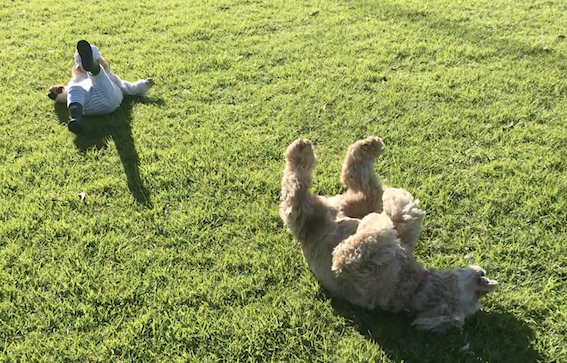
Rolling.jpg


Child-worlding bodies attuning to the ongoing. The relationality of an everyday multiple knowing. A present and past body sensing as entangled matter. There is a moment, a pause, a silence, recognition of ecological kin tracings, like tendrils of a floating sea jelly, rising and falling in the waves they pulsate in the everyday. Worldings of imaginaries.  According to  Haraway (2008) the world is constantly done and undone through ‘encounters’ which are not always those we expect. Touch ramifies and shapes accountability how living as relating engages bit pleasure and obligation. Touch is world making By attending to Haraway’s (2016) notion of relational natures of difference, I use a diffractive lens to be responsive to patterns that map not where differences appear but rather to map where the effects of difference between Wren and her companion

rollings over

rollings over

encounterings

mimicry

free

grasses

greening

stretching

scratching

bodies

shadowing

deepening

recognition

grasses greening

grasses greening

not only

entwined

joys

tangled

knowing

rollings over

rollings over

kin

As researcher of Wren noticing attunes me to this world otherwise left unrecognised, connecting beyond bodies allows a deep knowing, recognition; a sensing of bodies ecologically it forces us all into a new kind of relational ontology – human child who thinks with and through Gidyira (kin) with dog. Child-dog entwined in the joy of being animal. Child body mimics rollings over through her body with the dog, being with grass in the sunny field of an urban park. She looks to see ‘are we still worlding this moment together’, then continues on. The dog looks to her and notices ‘we are being together in our grassy rollings over’ and begins rolling over some more.

“Companion species” writes Donna Haraway in her book Staying with the Trouble are “relentlessly becoming-with. The category companion species helps me refuse human exceptionalism and invoke versions of posthumanism. In human-animal worlds, companion species are ordinary beings-in-encounter in the house, lab, field, zoo, park, truck, office, prison, ranch, arena, village, human hospital, forest, slaughterhouse, estuary, vet clinic, lake, stadium, barn, wildlife preserve, farm, ocean canyon, city streets, factory, and more.”

The diversity of my sensory becommings, a spontaneous convergence with the things I encounter, ensures an interweaving between my body and other bodies—this magical moment permits me, at times, to feel what others feel. The gestures of another being, the rhythm of her voice, and the stiffness or bounce in her spine,  gradually drawing my senses into a unique relation with her, into a coherent, if shifting, organization. And the more I linger with this other this entity that is animal, that is dog, the more coherent the relation becomes, and hence the more completely I find myself face-to-face with another intelligence, another center of experience that is part of my body now, tracings left behind. A quarter of a billion years ago the earth went through a period called ‘the great dying’. An extinction event where ninety-six percent of the species of plants and animals on the planet were lost, it nearly ended all life on the planet. Humans and all nonhuman species currently living on the planet are descendants from that surviving four percent of life. These “Ghosts point to our forgetting, showing us how living landscapes are imbued with earlier tracks and traces”

Through encounters with Gidyira (kin) we search for entangled tracings of past, present and future worldings, these  moments of sensorial opening captured by the video episodes are spaces to be with the world beyond humanist limits, that thwarted my entering into a living relation with the expressive character of all things.

++++++++++++++++++++++++++++++++++++++++++

Multi-species Co-habitation comes with a sense of responsibility when we are kin together we also must care and have shared sense of belonging and responsibility for our human non human kin. The child-more than human intra-action and cohabitation provides a space for mutual reciprocity, care and protection, to be thrown together, to be living well together means animating the posthuman predicament developing mutual reciprocity, care and protection, Living well together, being worldly with kin (Malone, 2018).

Sensing ecologically embraces bodies communicating with nonhuman entities: animals; plants; the weather; air; water; and sprits. The sense of the world is the touching of bodies each against the other, a touching sensed ecologically in different ways by different beings and different species of beings. Meaning through bodies; sensual knowing emerges as the means for making sense of entities, in the act of sensing.

As an ecological researchers and early childhood educators we are exploring the potential of a wild worlding exchange between bodies as sensorial openings and the things that engage them. Engaging with the writings of Hultman and Lenz Taguchi (2010) where the child is emergent in a relational field, “a space in which non-human forces are equally at play and work as constitutive factors in children’s learning and becomings” (p. 257).  Challenging “anthropocentric ways of seeing and doing analysis of educational data” (p. 257). Looking for pedagogies outside of learning that is observation and language focused.  We are seeking to disrupt and unlearn pedagogical practices that focus on naming the world, engaging with predetermined objects or phenomena that are structured with limited sensorium possibilities. We propose instead a pedagogy of noticing and attuning to a young child’s sensorial ecological encounters. Bodies sensing ecologically allows for a pedagogy of walking, slowing, deepening, foraging and attuning as pedagogical practice. This work requires an unlearning of anthropocentrisim, a troubling of the privileging of language, text as central to child body knowing – it is a coming together with critters, a staying with the trouble . “Critters—human and not—become-with each other, compose and decompose each other, in every scale, it is a ‘sympoietic tangling … earthly worlding and unworlding”. (Haraway 2016).

This blog draws on a paper published by Sarah Jane and Karen titled: Sensing Ecologically through Kin and Stones in a 2019 Special issue of the  International Journal of Early Childhood and Environmental Education focusing on Precarious Times: Posthumanist Possibilities for Early Childhood Environmental Education.

References

Abram, D. (1996). The spell of the sensuous. New York: Vintage Books.

Aldred, J. (2014). Past movements, tomorrow’s anchors. On the relational entanglements between archaeological mobilities. In J. Leary (Ed.), Past mobilities: Archaeological approaches to movement and mobility (pp. 21-48). Farnham: Ashgate Publishing.

Barad, K. (2007). Meeting the universe halfway: Quantum physics and the entanglement of matter and meaning. Durham: Duke University Press.

de la Cadena, M. (2015) Earth beings: Ecologies of practice across Andean worlds. Durham: Duke University Press.

Haraway, D. (2008). When species meet. Minneapolis & London: University of Minnesota Press.

Haraway, D. (2016). Staying with the trouble: Making kin in the Chthulucene. Durham: Duke University Press.

Hultman, K., & Lenz Taguchi, H. (2010). Challenging anthropocentric analysis of visual data: A relational materialist methodological approach to educational research. International Journal of Qualitative Studies in Education, 23(5), 525-542. DOI: 10.1080/09518398.2010.500628

Ingold, T. (2010). Bringing things to life: Creative entanglements in a world of materials. National Centre for Research Methods, University of Manchester, Manchester, UK.

Ingold, T. (2013). Making. Anthropology, archaeology, art and architecture. London: Routledge.

Malone, K. (2018). Children in the Anthropocene: Rethinking sustainability and child friendliness in cities. London: Palgrave Macmillan Publishers.

Malone, K and Moore, S.J., (2019). Sensing Ecologically through Kin and Stones, International Journal of Early Childhood Environmental Education, 7(1), p. 8-25.

Moore, S. J. (2019). Intercultural story sharing in Guam. The International Education Journal: Comparative Perspectives, 17(2), 30-39.

Nancy, J. L. (1997). The Sense of the World. Minneapolis: University of Minnesota Press.

Walking-with children on blasted landscapes

Walking-with is a time-travel-hopping (Barad 2017) in the embodied material labour of cutting through/undoing colonialist thinking in an attempt to come to terms with the unfathomable violence of repeated colonialization, genocide and destruction.  The trumpet plays the masculine Anthropocentric salute, while a host of onlookers have their troubling chatter silenced.  They will not talk of the radiation, the nuclear bombs, the polygon, the teachers and UNICEF staff tell me. Yet in these openings of walking-with pedagogies the child-earth bodies walking with me share, haunting stories of fear, fascination and body radiation occupation.

It is 2014, I am travelling to Semipalatinsk a city on the outskirts of the Polygon nuclear test site on the ‘Steppes’ in eastern Kazakhstan. After flying to Ust Kamenogorsk I am now traveling the 400 kilometres to the city via an old Russian taxi. Half way along our journey the driver pulls over to a dusty gas station. I decide to wander inside the small station shack to purchase some water.  Once inside I encounter a mother with a small child, a number of old men standing behind the counter all are looking towards the back of the room. In the corner of my eye I see a man dressed in a white onsie suit and face mask. He holds an apparatus, I realise it is a Geiger counter.  He motions me to come forward. I stand nervously, sweat beads start to accumulate on my lip as the beep, beep, beep runs across my body. I close my eyes and imagine laser beams flashing on radioactive particles that are currently crashing colliding violently and destroying delicately balanced cells. Laying silent hiding themselves deeply, dormant– the machine stops. I open my eyes; the man waves me on. I am done – I move to the door  – the water can wait – a set of fear stricken eyes are following my body, it is the young child held closely by her mother, waiting to be scanned – as I open the door dust sweeps across my face, particles settle deeply in my nostrils. I blow my nose.

Walking-with children on blasted landscapes, means walking-with to notice, attune with sensorial knowing as bodies sweaty, heavy lifting with/through the unknowing. Monsters walk with us – helping us to notice landscapes of entanglement, bodies with other bodies, time with other times (Tsing et. al., 2017). Children take me walking with on toxic blasted radiated landscapes.  Afterwards I write children recognize the fragility and porosity of human and non-human life and its link to the contaminated earth. Kazakh indigenous and settler children walking on landscapes speak of dust, dirt, thick uneasy air, toxic radiation. Walking with children allows for deep relational knowing, we talk through with and being in place; place walking becomes our shared rhythm; the children bring me into their place. We take some photographs, I allow some words to resonate, turning over and over I re-turn to them and write then down when I am alone some time later. I concentrate on being present, a co-presences of beings-in-common; children worlding with the ignorant unknowing stranger, Donna Haraways ‘modest witness’.

Historically, the territory of Kazakhstan was mostly inhabited by nomads. The imaginary of the nomadic body is one of being unlocatable, always moving with and entangled in the weathering landscape (Wuthnow, 2002). Until the sixteenth century, the nomadic Kazakhs had evolved as three jüz or territories. But repeated colonization, genocide and apartheid as shared with similar storying of indigeneity around the world, the Kazakh nomad was capturing by external powers whom were set to colonize the ‘empty’ spaces.  By the mid-eighteenth century, in order to fend off the threatening Kokand Khanate and facing encroachment from Tsarist Russia to the north and advancing Chinese armies in the east, the Kazakhs accepted Russian ‘protection’ in 1822. By the mid-nineteenth century, all of Kazakhstan were consumed within the Russian Empire. Following the Russian Revolution of 1917, and subsequent civil war, the territory of Kazakhstan was reorganized several times before becoming the Kazakh Soviet Socialist Republic in 1936. During the 1930s and 1940s Kazakhstan experienced population inflows of millions of exiled humans from the Soviet Union, deportees were interned in large labour camps, many of these were in the region of Ust Kamenogorsk and Semipalatinsk. In 1947, two years after the Second World War ended, the USSR’s main nuclear weapon test site the Semipalatinsk Test Site was founded near the city of Semey.  Over 460 atomic bombs were detonated at this site over a 40-year time frame. Following the dissolution of the Soviet Union, Kazakhstan declared independence on the 16th December 1991. At the time of the Soviet Union collapse only 40% of the population was indigenous Kazakh, the Kazakh language had all but been abandoned and most Kazakhs were living in adjunct poverty and desperation in regional towns that were due to the expansive Russian industries and mining that scarred the landscape and the atmosphere were highly polluted from toxic chemicals.  Independence also meant Kazakhstan inherited 1410 nuclear warheads and the highly contentious Semipalatinsk nuclear weapon testing site. By April 1995, Kazakhstan had repatriated its nuclear warhead inventory back to Russia and, by July 2000, had destroyed the nuclear testing infrastructure at Semipalatinsk. During a 50-year period millions of adults, children, animals and birds had been exposed to high levels of nuclear radiation and radioactive pollution.

To attend to, and be affected by the uneasy childearth encounters through walking in the streets of Semipalatinsk, is to recognise the porosity of matter, past radiation, pesticides, and heavy metal in our waters, dust, air, bodies –  playgrounds of unknown possibilities,  as everyday catastrophic encounters that have been, and continue to be, the monsters walking with us.

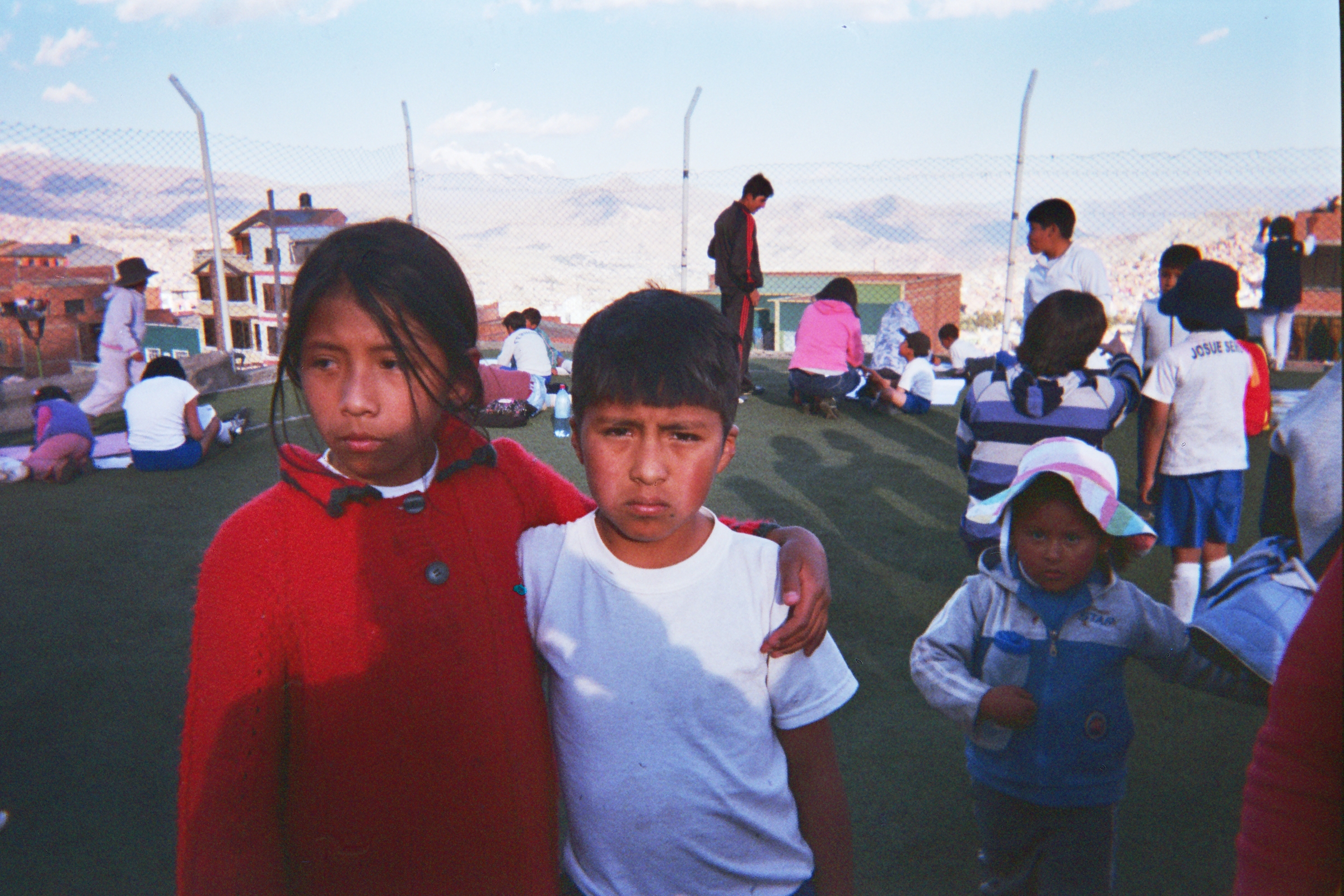
Walking-with our shared bodies on flat dirty dusty earthy street Anna remarks:  “I love mountains because there are no mountains in our city. I love nature and animals. I would like to walk in the mountains, which would be interesting. And I would want to dance because of being happy to be walking and breathing fresh air and away from the radiation of the polygon”. 

The theoretical frame informing this walking emerges from the unravelling of an ontology of human exceptionalism, the ‘western capitalist human story” of mastery and manipulation of particles that now lay scattered across the thin skin of the landscape, re-turning in temporal diffractive reconstructions. Single particles coexist in different space time. As a troubling relational ontology, the notion of the posthuman disrupts a persistent ‘humanist’ paradigm by allowing new conversations to emerge. Where were we you might ask, while military, corporations and machines metastasized into monstrous creatures of capitalism, and at what point did we ignore/become deaf to the clarion call of the Anthropocene? There has been critique from many in regard to the naming of the Anthropocene because of its universalist nature. Universalism produces an assumption that we (humans/nonhumans) are all in this equally together. This universalizing of the human predicament neglects to acknowledge the ways in which wealth, nationality, ethnicity, gender, class, age, location and so on mediate our relationships with the planet. As a disrupting, diffractive ontological tool posthumanism  has the potential to reveal there is no homogenous/universal species and the scale and impact of ecological damage is always unequal, unethical and unjust; indigenous  colonialised peoples, woman, children, and the other-than-human species we share this planet with are in it more than those entrenched in dominant western white masculine cultures.

As a diffractive theoretical thread this walking with children brings the past, the present and the future together walking as encounters with the ruinations of a precarious monstrous planet (Barad 2017b, Tsing et. al 2017).  This walking is far from the leafy green streets of Melbourne where I live. Where backpacks and children chatter and walk swiftly, kicking Autumn leaves.  Seductive simplifications of industrial production have rendered most blind to monstrosity in all its forms by covering over both lively and destructive connections. They bury once-vibrant rivers under urban concrete; radiation particles settle nurtured flourishing in the warmth of growing bodies.  It obscures increasing inequalities beneath discourses of freedom and personal response-ability. Somehow, in the midst of these ruins, the children and I walk with earthly assemblages, rocks, dust, radiation, water and porous bodies maintaining curiosity, noticing the strange and wonderful as well as the terrible and terrifying. The geo-storying of assemblages with ethnographic attentiveness – products of the modernist, capitalist projects -offer starting points for such curiosity, along with vernacular and indigenous knowledge practices and approaches. Such curiosity means working against singular notions of modernity. As we walk, I memorise the many question that situate themselves in my body – I want to revisit these later. As we are walking, I ask one of the children to explain to me what the large steel piping is that I see weaving its way through the streets we walk.

‘That is the hot water’ Yuliya tells me, ‘inside the pipe is very hot steaming water that warms out houses. Once the pipe burst and people were burnt badly. I have seen hot steaming water flood down the street, and I had to jump out of the way. It melted holes in the snow’. 

How can we repurpose the tools of modernity against the terrors of progress to make visible the other worlds it has ignored and damaged? Living in a time of planetary catastrophe thus begins with practices of humility and difficulties: noticing the worlds around us. Our monsters and ghosts help us notice landscapes of entanglement, bodies with other bodies, time with other times (Tsing et. al 2017). The Kazakh government struggles to balance its desire to be seen as a country that is anti-nuclear, yet it has some of the largest uranium mining sites in the world. The pull and desires of economic security while worlding with others as victims of colonial exploitation. A UNICEF colleague tells me,

“The reason the government wants to erase this issue of the past radiation is because Kazakhstan wants to sell more uranium to the global marketplace. We have plenty of uranium here. We are not allowed to sell much, there are certain limits.”

But what is the scale of time, time scales in radiated worlds?

“When the cascading energies of the nuclei that were split in an atomic bomb explosion live on in the interior and exterior of collective and individual bodies resetting decay times of cellular clocks, how can anything like a fixed, singular, and external notion of time retain its relevance or even its meaning?”  (Barad, 2017  p. 63).

Walking with children seduces me into these temporal diffractive possibilities Plutonium-239, has a 25,000 year half-life.

In a flash, past bodies living in the immediate vicinity of the Polygon the site of over 450 atomic bomb detonations ingest radioactive isotopes that indefinitely rework body molecules, all the while manufacturing future cancers, like little time bombs (Barad 2017a) walking with children is to be waiting with bombs to go off.  What constitutes the event of an atomic bomb that explodes at one moment then over time continues to go off in bodies of kin?

Barads paper Troubling Time/s and ecologies of nothingness engages with my thoughts her words resonate over and over in my thinking; she walks with us.  “The temporality of radiation exposure is not one of immediacy; or rather, it reworks this notion” which must then “rework calculations of how to understand what comes before and after, while thinking generationally” (Barad 2017a, p. 63). Barad’s thinking sings in my thoughts as I re-turn to her paper running it over and over, attending to the liveliness of radiation and how it disrupts all concepts of time and temporality: “…radioactivity inhabits time-beings and resynchronises and reconfigures temporalities/ spacetimematterings” (Barad 2017a, p. 63). Walking with children on/through radiated landscapes, time is this messy entangled space is unstable, “Radioactive decay elongates, disperses, and exponentially frays time’s coherence” time in this walking-with children is always in the process of “leaking away from itself” (Barad 2017a, p 63).

Plutonium, a heavy metal, emits alpha radiation, and the material is most harmful when inhaled or ingested. There are ‘hot sites’ where residual radiation is still present in the earth. On the testing site scientists find high levels of plutonium in horse bones – Kazakh shepherds use these bones to make soup. Horse soup and horse milk flows warmly on cold nights through small bodies. Aytem stops walking to introduce me to his neighbour. A kindly older woman who works at the local fruit shop.

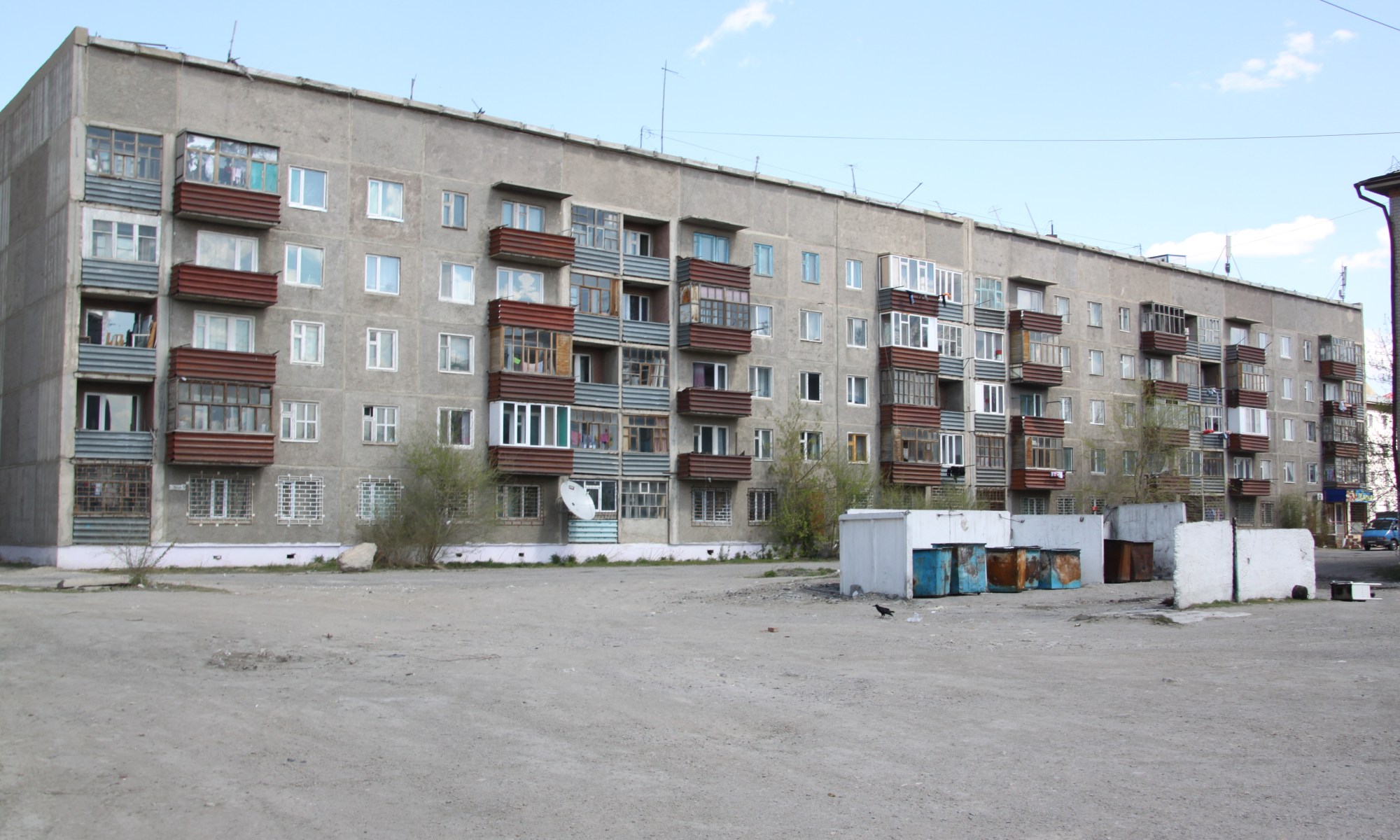
‘She is my friend, she is old, but she often makes me Kumis (fermented horse milk) to help me sleep’. Aytem lives in the 10th floor of an apartment block. In later workshops he brings a photograph looking form his apartment window, He never leaves the apartment when his parents aren’t there to play alone, he worries about the dirt and dust in the playground. He said it scares him he might become sick. He arrives to the workshops and when we walk today in a neatly pressed formal suit. He tells me his parents have told him it is important to use this opportunity to give his point of view because we are important government people. He speaks often and with confidence. 

Karin Murris (2013) nudges me to consider these injustices, epistemic injustices are not just social, but also within this ontoepistemic are quiet moments.  Children are not listened to because of their very being (onto); as child unable to make claims to knowledge, because it is,  “assumed that they are (still) developing, (still) innocent, (still) fragile, (still) immature, (still) irrational (still) becoming” (Murris, 2018, p.2) – (still) monsters. Did I say children are monsters?  No, it is the mutated radiated microbiomes that inhabit the deep corners of their porous beings I am afraid of. Who are these entangled monstrous beings?

Walking-with children those who are deemed unworthy of recognition and are invisible in the anthro-obscene manifestations of western capitalism. Here is to walk into the past with ghosts and to share the horrors of a dystopian future. Hide it, don’t show the world, this never happened. Queering with diffractive theorising as speculative fabulations the practice of walking-with the past, present and the future is to recognise the complexity of spacetimemattering. An entangled set of possibilities are revealed through the invoking of an alternative set of stories conjured up with children through being-in-place with a host of other re-configuring relations. Are you still walking with me? Who are your adult researcher body from across the oceans claiming to know how it feels to be an earth-child body, to be a container for generations of radiation trauma?

As with the sufferings of residents of the former plutonium-manufacturing districts of Russia, Australia and the USA – where radioactive traces still course through soil and water bodies, the porous bodies of the children I am walking with in Semipalatinsk are suffused with illness and unease. Childbodies medicalised, labelled, scanned, cleared of traces relating to illnesses from the past plutonium exposure.  But deep between the surface chronic doses of radiation are stimulating bacterial mutations. It seems many children suffer from the ills of their monstrous sympoietic relations with disrupted microbial companions (Haraway 2017, McFall-Ngai, 2017). Monsters are the wonders of sympoiesis, threats of ecological disruption, virulent new pathogens to out-of-control chemical processes.

Children walking with “symbiotic relations must be constantly renewed and negotiated within life’s entanglements. When conditions suddenly shift, once life-sustaining relations sometimes turn deadly” (Tsing et. al 2017, M5). Donna whispers to me ‘To be one is always to become with many’ (Haraway 2016).  “Symbioses are vulnerable; the fate of one species changes a whole ecosystem” (Tsing et. al 2017, M5).

Jars of deformed dead bodies are contained in a local museum. The children of our study tell me they have seen these ‘bodies’ penetrated by monstrous matter. Like the tumorous dogs we see while walking, these silenced bodies floating in fluid over time “provoke fear but also fascination as their ghostly presence, same but not quite threatens to reposition or dissolve the boundaries of normality”. (Goodley et al., 2015, p. 3)

“The killing of ‘monstrous’ babies born with ‘deformities’ has been traced back as far as the time of Aristotle’ and ‘In more recent times, monstrosity was the justification for the “euthanasia programmes” that systematically killed hundreds of thousands of disabled children”. (Goodley et al. 2015, p. 2)

In these precarious times it continues to be important to consider an approach that seeks to de-centre the human; to be attentive to the re-doing of material configurations and spacetimemattering. The past, the present and the future are always being reworked.  This is ethical work. (Barad interviewed by Dolphijn, and van der Tuin, 2009). According to van der Tuin (2014) Feminist new relational materialist models, like the ones described by Barad “scramble conventional notions of subjectivity that separate the rational human from an external environment” (pp.232-3).  Theorizing using Barad’s agential realism means moving beyond posthumanism which can be seen lacking in matters of ethics:

“… questions of ethics and of justice are always already threaded through the very fabric of the world. They are not an additional concern that gets added on or placed in our field of vision now and again by particular kinds of concern. Being is threaded through with mattering. Epistemology, ontology, and ethics are inseparable. Matters of fact, matters of concern, and matters of care are shot through with one another. Or to put it in yet another way: matter and meaning cannot be severed. In my agential realist account, matter is a dynamic expression/articulation of the world in its intra-active becoming” (Barad interviewed by Dolphijn and van der Tuin, 2009, p. 69).

As I am walking-with children they comment:

 ‘We are afraid of the street dogs. Dead dogs stink’. Deformed babies deformed dogs; Dead dogs’ dead babies.  ‘Do you know about the nuclear tests?’ they ask as we walk. ‘Yes, I say I did know’. ‘It is inside us’, one child remarks, ‘it is probably in you now’.

I blow my nose, we walk on. 

References

Barad, K. (2017a) Troubling time/s and ecologies of nothingness: re-turning, re-membering, and facing the incalculable, New Formations, 92, (Special issue  Posthuman Temporalities), 10.3898/NEWF:92.05.2017

Barad, K. (2017b), No Small Matter: Mushroom Clouds Ecologies of Nothingness and Strange Topologies of Spacetimemattering, in Tsing, A., Swanson, H., Gans, E., and Bubandt, N. (eds) Arts of Living on a Damaged Planet, University of Minnesota Press, USA. pp. G103-M120.

Haraway, D. (2016). Staying with the Trouble, Duke University Press.

Haraway, D. (2017), Symbiogenesis, Sympoiesis, and Art Science Activisms for Staying with the Trouble, in Tsing, A., Swanson, H., Gans, E., and Bubandt, N. (eds) Arts of Living on a Damaged Planet, University of Minnesota Press, USA. pp. M25-M50.

Dolphijn, R., & van der Tuin, I. (2009). Matter Feels, Converses, Suffers, Desires, Yearns and Remembers: Interview with Karen Barad. Viewed 2 June 2016. http://quod.lib.umich.edu/o/ohp/11515701.0001.001

Goodley, D., Runswick-Cole, K., & Liddiard, K. (2015). The DisHuman Child. Discourse: Studies in the Cultural Politics of Education. https://doi.org/10.1080/01596306.2015.1075731.

McFall-Ngai, M.,(2017), Noticing Microbial Worlds: The Postmodern Synthesis in Biology,, in Tsing, A., Swanson, H., Gans, E., and Bubandt, N. (eds) Arts of Living on a Damaged Planet, University of Minnesota Press, USA. pp. M51-M70.

Murris, K. (2013) The Epistemic Challenge of Hearing Children’s Voices, Studies in Philosophy and Education, 32(3), pp. 245-259.

Murris, K. (2018). Posthuman Child and Diffractive Teacher: Decolonizing the Nature/Culture Binary, in Cutter-Mackenzie A., Malone K., Barratt Hacking E. (eds) Research Handbook on Childhoodnature. Springer International Handbooks of Education. Springer, Cham.

Tsing, A., Swanson, H., Gans, E., and Bubandt, N. (2017) Arts of Living on a Damaged Planet, University of Minnesota Press, USA.

Van der Tuin, I. (2014). Diffraction as Methodology as Feminist Onto-epistemology: On encountering Chantal and Chawaf and Posthuman Interpellation. Parallax, 20(3), 231–244.

Wuthnow, J. (2002) Deleuze in the postcolonial: On nomads and indigenous politics, Feminist Theory, 3 (2), p. 183-200.


This blog post has been reproduced from a panel paper presented at AERA , Toronto, Canada, 2019 and emerges form studies of the Bodies on Damaged Landscapes a theme of the Children in the Anthropocene Project. 

Panel Title: Storying land, consent, and radical relationality as practices of walking-with.

The 4 papers convened for this session foreground the ways that story and walking are intimately connected to critical place-making. The papers activate place as vital and relational through a practice of walking-with. Walking-with is a deliberate strategy of unlearning and unsettling as place-making. Walking-with is responsive to stories of land, and different ethical modes of participation that are situated and relational. Drawing from queer theory, Indigenous knowledges, critical place inquiry, critical race theory, papers on the panel discuss 4 separate walking projects that understand place as intimate, sentient, and vital.

The Panel Session Submission was for Division B and Chaired by Stephanie Springgay.

Mobilities: landscapes as assemblages

Fig5.8

Mobilities Flow, freedom and movement of human and nonhuman beings acting in the world are constituted as inter-subjective mobilities. Understanding the materiality of mobilities, how bodies flow through places and spaces with and through materials are as Aldred (2014) notes central and important to research on bodies in the landscape:

 How one moves during fieldwork has important consequences for the interpretative process, and presented movement as a conjunction between body and landscape … in order to study movement there is a need to understand it not dialectically, in-between static materials and moving bodies, but rather through the flows in which these two become co-constituent in movement. (Aldred 2014, p. 40)

The landscape is an assemblage with flows of materials running through it, rivers, rocks, earth, sunlight, wind; it is a moving omnipresent not a static backdrop to human or animal activities (Edgeworth, 2014). The high slopes are the most unstable with lake sediment deposits. The higher, steeper slopes are also the wettest; they are by far the most landslide-prone slopes within the city. The houses are swept away, buckled and broken slowly with the earth slumping, the movement edges its way down the valley slope.  Houses containing children slip down the valley. Phenomenon could be described as the intra-action between an object and its surroundings. This intra-action leaves discernible marks on those surrounds so as to constitute them as a measuring apparatus of the intra-action. Barad (2007, p.335) argues:

… apparatuses are not merely human-constructed laboratory instruments that tell us how the world is in accordance with our human-based conceptions. Rather, apparatuses are specific material configurations (dynamic reconfigurings) of the world that play a role in phenomena.

Barad (2007) uses the term ‘intra-action’ to describe how two poles of a phenomenon, the object and the apparatus, do not exist as such apart from their intra-action. What is measured by those marks of intra-action, however, is not a property of the object in isolation, but of the phenomenon as a whole.  In chapter five of the book Children in the Anthropocene I explore the concept of mobilities. I consider how we can think of freedom and movement differently if its ontological roots aren’t located in a pure determinist, phenomenological humanistic paradigm. That is, ‘(f)reedom is not a quality or property of the human subject … but can only characterize a process, an action, a movement that has no particular qualities’ (Grosz 2010, p.147).  Freedom is not then about choice or options, the acquisition of objects – I am free to make choice while others aren’t (Grosz 2010). To be ‘free’ in this sense is a freedom of action, it is connected to ‘embodied being, a being who acts in a world of other beings and objects’ (2010, p.147). Freedom is closely connected then to concepts around movement, the materiality of movement, to the reconfiguring of what comes to be viewed as autonomous acts of freedom.   The children in the three neighbourhoods of La Paz were asked to draw on a map of their movements through the landscape. These marks on the map are as Barad alludes to a ‘measurement of intra-action’ – they record the ongoing dynamics of boundary making (marking) practices of children with the landscape. The marks provide a record of each neighbourhood and how children move differently and together through these landscapes. And as they move with and through and intra-act with objects, they leave traces of their past and present.

Cotahuma

Fig5.6COTmap

Map 1: Mobilities of children becoming with landscapes at Cotahuma

This first map shows the children becoming with landscapes in Cotahuma. The maps provide children’s movement not as autonomous individuals but rather as a collective phenomena of child-city-movements as material dynamic entangled objects becoming through the landscape.  They provide entry points when observing the entangled nature of practice as it unfolds:

[P]athways or trajectories along which improvisatory practice unfolds are not connections, nor do they describe relations between one thing and another. They are rather lines along which things continually come into being. Thus when I speak of the entanglement of things I mean this literally and precisely: not a network of connections but a meshwork of interwoven lines of growth and movement (Ingold 2010, p. 3). 

Elena’s reflects on childhood play in La Paz, she states:

In our free time we played just on the earth, we didn’t have a  play ground we just played with the air, go to the garbage play on the garbage. In my neighbourhood before was so dirty, the river was open and you can smell the water was dirty.  And people other communities use to come to there to throw all the garbage near the river and some factories carry some magazines books to throw out near the river and we as a child use to run to see what they had thrown. Maybe we can get some magazines things like that. That happened when I was 10 years old. I remember always I use to have dirty clothes (Recorded interview 2014).

The spider weaves their threads starting from the centre, building layers by knotting carefully each thread. The boundaries are created by supporting the trailing of loose ends that fall away. The network of lines, the flow of materiality of child-city-movement provides the possibilities for real and imagined journeys where the human and non-human are connected. The defining attribute of a network of flow lines is their potential for connectivity. Ingold (2010) states:

The lines of the spider’s web, for example, unlike those of the communications network, do not connect points or join things up. They are rather spun from materials exuded from the spider’s body and are laid down as it moves about. In that sense they are extensions of the spider’s very being as it trails into the environment. They are the lines along which it lives, and conduct its perception and action in the world ( p. 12). 

Tacgua

Fig5.4TACmap

Map 2: Mobilities of children becoming with landscapes at TacGua

Life, according to Deleuze and Guattari (2004), is developed along thread-lines (Ingold 2010). These thread-lines of life are referred to by them as ‘lines of flight’, or ‘lines of becoming’. Like the markings of the children through the landscapes of La Paz these are not lines that connect; they are the unfolding of possibilities for how materiality is flowing through the spaces between the earth and the walking. A freedom of flow is taking up agency through child-earth becoming. The ‘thing’ the gathering together of lines of flight is according to Ingold (2010) is how Deleuze and Guattari explain the concept of a  “haecceity” (2004, p. 290).  The haecceity or thisness of things is represented through this mapping of collective lines of flight. At the centre of the Tac Gua map we can see a number of swirling lines centred around a particular object. The object is the play and sports space – it is also the centre where we held our workshops. Running vertical to these the crooked lines illustrate the staircases where children can exit to the top of the valley and ravine into the El Alto or horizontally outwards into the forested disused vacant blocks where the valley is so steep constructing houses or stairs is impossible or what was there has now been lost; washed away by a landslide. Walking, walking, carrying, carrying, puffing, puffing – up the steep staircases. The pathways are empty. Bare dirt fills the spaces in between. Hidden from view, the narrow walkways look our across the valley.

fig5.5

Stairs as lines of flight 

A line of becoming’, Deleuze and Guattari (20write:

… is not defined by the points it connects, or by the points that compose it; on the contrary, it passes between points, it comes up through the middle … A becoming is neither one nor two, nor the relation of the two; it is the in-between, the … line of flight …  

Children’s movement and freedom as represented through their intra-acting with and through the dirt, dust and water of the ravines provides insights into the materiality of being with the earth through an embodied reality of moving through place. It is not the place or destination that is central to these child-city-movements but a mobile materiality that allows the child’s entangled world to be revealed Or as Ingold (2010, p. 3) entices us to consider, ‘a focus on life-processes requires us to attend not to materiality as such but to the fluxes and flows of materials’.

Munaypata 

Fig5.2MUNmap

Map 3: Mobilities of children becoming with landscapes at Munaypata

The marks on the landscape portray the messy flowing streets of Munaypata following the valley terrain and the means through which children have individually and collectively devised complex pathways through the congested urban landscape. The steep crammed valley; with houses built on top of each, providing no space or paths or roads creates. The heavy flows of movement are connected to activities within streets, open areas, parks, playgrounds, and sporting fields.

Elena’s reflections on a childhood with dirt and landslides:

I walked. I always walked I never took the car or bus.  Because the road I use to go was hilly and when it was the season of raining – the road was earth, the road was slippery and I use to fall down and I remember my shoes were always were dirty with all the earth. With the earth that’s what it was like. We get access to the football field, was field near the river too and we use to go and play and run or play football. We didn’t get access to a good real playground it was too far away

When I was a child there was a landslide. My house was on the edge where all the other houses near me all fall down. Ours was the only one left. We stayed in that house on the edge of cliff for five years after that. When my house was on top of the edge my mum and me still stayed there but my bedroom did not have a door – we had a small place to walk but my porch and the other part of the house fall down. We just put some wood and have to use a ladder up the cliff to get to the house. We had to carry the water it was very difficult. In that house I was very sacred. When it starts raining I am afraid scare maybe the house will landslide again. I had my packed ready to go some I have to take it with me. (Recorded interview 2014).

The flowing in and out of the central area that is the neighbourhood of Munaypata tracks the means through which children enter in and out of the space along the ravine edges to move downtown to where the schools are and where their parents are working. They return back up the ravines to the neighbourhood where they find small areas of open space, some earth to play out of eyeshot of adults who may have presented risks. Sheller and Urry (2006, p. 217) argue while much of the research on movement is conducted at a distance it should also be equally concerned with ‘the patterning, timing and causation of face-to-face copresence’.

The texture of the ground, steep slopes, loose earth; the weather wind, rain, darkness; vegetation forests, woodlands; and the others that we share the ground with all influence and force certain types of movements, freedoms, constraints and mobilities (Leary 2015). And as Ingold and Vergunst (2008) remind us we are in relation with a world teeming with a vast array of non-human animal life, all of which influence how we move, with whom we move through the landscape and the trails we leave behind (Leary 2015). Gibson argued many years ago through his affordance theory that animals and humans stood in  ‘systems’ or ‘ecological’ relation to the environment, such that to adequately explain some behaviour it was necessary to study the environment or niche in which these entangled relations took place.  Humans like other animals know the world through moving and acting in it. Therefore they exist in a dynamic relational system with their surroundings –  humanity has relied on this system of human-non-human place relation longer then this short epoch of the anthropocene where we have sought to reconstitute human as separate/outside of nature… unpacking the diversity of children’s mobilities and how these are embedded and embodied in the everyday-ness of being in relation to the materiality and aliveness of ‘things’ in the city seems timely as an essential ingredient for the story of growing up in the Anthropocene.


References

Aldred, J 2014, ‘Past movements, tomorrow’s anchors. On the relational entanglements between archaeological mobilities’ in Past mobilities: archaeological approaches to movement and mobility, J Leary (ed.), Ashgate Publishing, Farnham, pp. 21-48.

Barad, K 2007, Meeting the universe halfway: quantum physics and the entanglement of matter and meaning, Duke University Press, Durham & London.

Deleuze, G & Guattari, F 2004, A Thousand plateaus, trans. B Massumi, Continuum, London.

Edgeworth, M 2014, Enmeshments of shifting landscapes and embodied movements of people and animals, in Past mobilities: archaeological approaches to movement and mobility, J Leary (ed.), Ashgate Publishing Limited, Farnham, pp. 49-62.

Grosz, E 2010, ‘Feminism, materialism, and freedom’ in New materialisms: ontology, agency and politics, D Coole & S Frost, S (eds), Duke University Press, Durham & London, pp. 139-157.

Ingold, T 2010, Bringing things to life: creative entanglements in a world of materials. National Centre for Research Methods, University of Manchester, Manchester, UK.

Ingold, T & Vergunst, J 2008, Ways of walking: ethnography and practice on foot, Ashgate Publishing, Farnham.

Leary, J. (ed) 2015, Past mobilities: archaeological approaches to movement and mobility, Ashgate Publishing, Farnham.

Sheller, M & Urry, J 2006, ‘The new mobilities paradigm’, Environment and Planning A, vol. 38, no. 2, pp. 207-226, doi: 10.1068/a37268.

This blog post is a modified extract of chapter 5 in the recently published book by the author Children in the Anthropocene. This is a Palgrave book published in the book series Childhood and Development. To find out more details or to purchase a copy of this chapter in full or the whole book you can find the information at the following Palgrave website:  http://www.palgrave.com/us/book/9781137430908

Exploring the Anthropocene as an unsettling ontology

munm0974

We are an incredible force of nature. Humans have the power to heat the planet further or to cool it right down, to eliminate species and to engineer entirely new ones, to re-sculpt the terrestrial surface and to determine its biology. No part of this planet is untouched by human influence – we have transcended natural cycles, altering physical, chemical and biological processes- Gaia Vince, The Guardian, September 2015

While the term ‘Anthropocene’ (the epoch of the hu/man), has been accepted in the geological discipline landscape, there has been much debate about where the boundaries lie that would mark the arrival of this new epoch. Was it the Industrial revolution in the 18th Century or the ‘great acceleration’ of the mid 20th century with its increasing population growth, carbon emissions, biodiversity loss, plastic production and start of the nuclear age with atomic bombs spreading detectable radiation to every strata of the planet (Davies 2016). The Anthropocene as used in my research is more than this, more than a timeline of human degradation or techno-positivist hubris. The Anthropocene reveals beyond the damage that there is no homogenous human race and that this scale of ecological impact is unequal, unethical and unjust; the poor, the children, and the nonhuman are more in it than the wealthy.

The term Anthropocene, has not emerged uncontested. Donna Haraway (and many others), have argued the naming of the Anthropocene constructs a certain model of the globe, a view that ‘the contemporary world is a human species act’ (Haraway et. al 2015, p. 1). She argues: ‘…in this moment of beginning to get a glimmer of how truly richly complex the world is and always has been, someone has the unmitigated arrogance to name it the Anthropocene’ (Haraway et. al 2015, p. 11). Nils Bubandt responding to Haraway acknowledges the disputed nature of the term but adds it has provided the opportunity for a galvanizing in academia:

 …the Anthropocene is a polluted concept, it is a contested concept, it is a problematic concept for all kinds of reasons. At the same time, it might still be utilized to do useful work, to galvanize already emergent forms of thinking and acting in academia. For instance, one could claim that it disrupts the global hierarchy of sciences. After all, it comes as an invitation to collaboration from the ‘hard sciences’, from the apex of the hierarchy of sciences, to the human and social sciences (Haraway et. al 2015, p. 14).

For many scholars in the humanities, especially education, these arguments should compel us to ask what is the role of education within the challenges this naming of the Anthropocene provides? As more come to recognize the impact of the new epoch will there be a clarion call for considering new ways that bring into question how we engage and educate with the ‘planet’ (including all nonhuman others) and how the ‘planet’ engages and educates with us?

This realization of the possibilities and implications of the events foregrounded in the era of the Anthropocene are compelling and while the concept is contested, in its contestation it evokes a desire in me to consider the enormous challenges its presents for all earthlings.  The Anthropocene, as expressed through the everyday, entangled lives of children growing up with a host of others in degraded city landscapes is the focus of my new research project and book: Children in the Anthropocene (Malone 2018). The key focus of this work is to consider how children (especially those in urban and less privileged positions) are implicated in discussions of the Anthropocene and how to represent and educate about these urban lives differently.

Gaia Vince writes cities are ‘microcosms of the planet fashioned for our [human] species and no other’ (2014, p. 338). Endeavouring to exist in this ‘entirely synthetic human creations’ are the children and nonhuman others whose stories appear as central to my research narratives but are mostly invisible in the techno-fixes of greening capitalism.  Theirs is the story of the great global urban migration – an outlier of the Anthropocene. Starting from a slow urban drift in past generations to what we see now; a massive tidal wave of humanity headed to live in the ambiguous spaces of some of the world’s largest cities, where often only traces of our pre-human existence.

City children are the most disadvantaged human group in the Anthropocene. They will not only grow up in the height of the Anthropocene; they will inherit its consequences.  Cities throughout human history have been difficult and risky places for children, with urban childhoods being played out in crowded, polluted environments, with limited opportunities to engage with nature, animals or other nonhuman elements. Living on the urban fringes of major cities in developing countries many children and their families live in poverty, exposed daily to a host of challenges. These challenges often contribute to a child’s inability to more freely and safely in order to play or work, or access schools and medical services.    But these issues for children are not new.

The argument supporting a recent child-city-nature disconnect relies on a belief that past generations of children had a closer and more intimate relation with the planet and de-emphasizes what has been ‘a long history of urban environmental degradation and childhood disconnectedness where the experience of being a child in the environment’ has not always been a positive one. This is especially true of the invisible childhoods of eighty percent of the world’s children who are not living white middle class western imagine lives (Malone 2017).

That is, the Anthropocene and its impact on children and nonhuman lives has been a work in progress since industrialisation. Over many generations of living being’s children and our nonhuman kin have suffered the most. As a capitalist project sacrificing a future life for the planet through its unrelenting desires for resources, it has been a measure of self-adulation of the human species positioning itself as earthly master. Working or living near factories; being exposed to pollutants in the soil, air, water; the loss of places to live due to rising sea levels; the impact of natural disasters; dying from radiation, these have all been the experiences of those species living on a planet in the face of an impending ecological crisis.  The Anthropocene reminds us we live on this damaged landscape; our porous bodies are susceptible to the contamination; our seemingly secure homes and jobs vulnerable; and with the likelihood of extinction of our species and a host of others impending – our future seems grim.

The Children in the Anthropocene book explores the everyday lives of children who reside in these fragile city environments. Education, health services, employment, shelter, food and water have become alluring possibilities that large urban environments bequeath an impoverished rural child. Through the global projects of ‘sustainability’ cities have become the ‘solution to the ecological crisis’, the problems of the age of humans fixed through human ingenuity. Cities proclaimed as the means for providing shelter and resources for the steadily increasing human populations, have placed us in conflict with planetary ecologies. Under the auspices of a capitalist apparatus on sustainable development and green capitalism; the rural and indigenous persons have been encouraged/forced to move from a country taken up by the corporates machine, on the dream of a better life.  Despite the hardships encountered, the draw is great, the Anthropocentric urban revolution promised children a healthier, educated life. But the lure of the city and the call of the Anthropocene, hasn’t always delivered its promises. Children in the Anthropocene seeks to reveal the complexities of children’s lives entangled with each other, their families, the communities of humans and the collective of human-nonhuman that are tied together; knotted in knots in intricate ecological communities in cities. They are revealing stories, illustrating the potential for a different way of being with the planet, one that is often invisible within the dominant humanist project.

Therefore, as an unsettling ontology that disrupts the persistent ‘humanist’ paradigm in disciplines such as education the concept of the Anthropocene allows new conversations to happen around human-dominated global change; human exceptionalism; and the nature/culture divide (Lloro-Bidart 2015). The Anthropocene rather than just scientific facts, verifiable through stratigraphic or climatic analyses, becomes a ‘discursive development’ that problematizes a humanist narrative of progress that has essentially focused on the mastery of nature, domination of the biosphere, and ‘placing God-like faith in technocratic solutions’ (Lloro-Bidart 2015, p.132). A useful heuristic device for gaining a deeper understanding of how we ‘humans’ have come to locate ourselves as master of a 4.5 billion year old planet when we have existed for the mere blink of an eyelid.  Gan et. al. (2017, p. G5) encourage us through our storying of the Anthropocene to ‘track histories that make multispecies livability possible’ by wandering ‘through landscapes, where assemblages of the dead gather together with the living’. They remind us the traces of the past live on through those kin who are amongst us; disasters and devastation formed our present; and that hope lies in considering these many pasts, as part of our future.

Are we on the final steps to sealing the fate of a myriad of species, including our own? Will the damaged landscapes left behind hold only thin traces of the human/nonhuman histories through which ecologies have been made and unmade? (Gan, Tsing, Swanson & Bubandt 2017). The naming of the Anthropocene, acknowledges this incredible force and nowhere is this impact more dramatic then in cities, and no species has more to lose then our children.

References

Davies, J. (2016). The Birth of the Anthropocene. California: University of California Press.

Gan, E, Tsing, A, Swanson, H, and Bubandt, N. (2017). Introduction: Haunted landscapes of the Anthropocene, in Tsing, A, Swanson, H, Gan, E, and

Bubandt, N. (eds) Arts of Living on a Damaged Planet, University of Minnesota Press: USA.

Haraway, D., Ishikawa, N., Gilbert, S. F., Olwig, K., Tsing, A. L., & Bubandt, N. (2015). Anthropologists Are Talking – About the Anthropocene. Ethnos, 81(3), 535- 564.  https://doi.org/10.1080/00141844.2015.1105838

Lloro-Bidart, T. (2015). A Political Ecology of Education in/for the Anthropocene. Environment and Society: Advances in Research, 6(1), 128–148. http://journals.berghahnbooks.com/environment-and-society.

Lorimer, J. (2012). Multinatural Geographies for the Anthropocene. Progress in Human Geography, 36(5), 593–612. https://doi.org/10.1177/0309132511435352.

Malone, K. (2017). Ecological Posthumanist Theorising: Grappling with Child-Dog-Bodies. In K. Malone, S. Truong, & T. Gray (Eds.), Reimagining Sustainability in Precarious Times. Singapore: Springer.

Malone, K. (2018) Children in the Anthropocene, Palgrave, UK.

Vince, G. (2014). Adventures in the Anthropocene: A Journey to the Heart of the Planet We Made, Canada: Milkweed Editions.

Vince, G. (2015, September 25). Humans Have Caused Untold Damage to the Planet. The Guardian. Viewed 1 March 2016. http://www.theguardian.com

Further information email Dr. Karen Malone  k.malone@westernsydney.edu.au

 Children in the Anthropocene book available: http://www.palgrave.com/us/book/9781137430908

Project Website: www.childrenintheanthropocene.com

Facebook: www.facebook.com/ChildreninAnthropocene/

This post is a summarised extract from the introduction chapter of the book Children in the Anthropocene and a summary of the speech given by Karen Malone (the author) at the book launch on 24 October 2017 @ Western Sydney university. The book is due to be released by Palgrave in mid-November, 2017.

Researching Children in the Anthropocene

Image: Researching with Children in La Paz Photograph by Author

Nothing epitomizes the precarious nature of the planet for me, then the view as you fly from the high mountain plateaus of the Altiplano towards the El Alto airport and see spread out in front of you the immense sprawling valley where the city of La Paz is perilously situated. The image of a vastness of crowded slum communities perched on the high reaches of the escarpment and spilling down into the steep, treeless, ravines and gorges of the valley are breath taking. The Anthropocene, a human imprint at a global-scale. A fragility of children and their nonhuman companions engaged in a dance of daily survival with shared vulnerability. The unsettling that the naming of the Anthropocene has administered – and will continue to administer – is a massive jolt to our collective imagination of ourselves. the irony we as a species, amongst others, find ourselves: both as the monster and maker. The concept of the Anthropocene assumes a generalized anthropos, whereby all humans and nonhumans are equally implicated and all equally affected. Through my research I seek to bring attention to the way the environmental crisis accentuates rather than diminishes differences between the privileged and the not so privileged. Because we are not all in the Anthropocene together, the children are far more in it than others. Wealthy humans have cultivated a global landscape of inequality in which they find their advantages multiplied in these highly fragile times. Philosophically, it is a concept that works both for us and on us. In its unsettlement of the entrenched binaries of modernity (nature/culture; object /subject), and its provocative alienation of familiar anthropocentric scales and times, it opens up a number of possibilities for exploring concepts such as assemblages, relations and kin. The research project Children in the Anthropocene is premised on the import of making kin, the ‘situatedness’ of being child relative to, and combined with ‘other’ kin. That we are all beings in common, entangled, sharing ecologically our posthumanist selves.

Stories that Matter
Throughout the past 20 years I have listened intently to children’s stories by noticing and paying attention to their experiences of growing up in relation with others (human and non-human). The research was both ethnographic and participatory in its methodology. To be responsive, place-based participatory research engaged by the researcher with children is attentive to noticing the fine grain differences and similarities, it seeks to encourage complexity rather than simplicity. When engaging with children in precarious environments this responsiveness supports opportunities for children from a variety of ages and genders, diverse lives, interests and experiences to take up and make choices of their responses to the possibilities that exist to engage with the research.

Children I researched with on the higher reaches of the valley of La Paz were aged between 5 and 15 years old. They volunteered to be co-researchers using visual, oral and mobile place-based research activities including photography, interviews, focus groups, drawings, mapping and walking interviews. The project focused on incorporating a research perspective through their everyday experiences of being curious, creative and playful in their place so supporting a range of possibilities for children to document relational encounters. For some communities in La Paz the children’s research workshop included opportunities for families to be involved. Parents or grandparents, brothers, sisters, cousins especially in the beginning, came along to watch, ask questions and even help out. Ethical considerations of negotiating children involvement meant working in outreach children’s centres in the community where months in advance social work students had provided information workshops and small meetings for children and their parents. As a feminist onto-ethnographer, I have also inserted myself in the research studies by documenting my experiences through a field diary, photographs and videos.

Theoretically, I have adopted an onto-epistemological research stance that assumes epistemology and ontology are mutually implicated ‘because we are of the world’, not standing outside of it. The theory of ecological posthumanism I have adopted contests the arrogance of anthropocentric/humanistic approaches, by enabling a multiplicity of ecologies where humans are neither exempt or exceptional, we are all beings in common. By adopting a stance of vital new materiality, I have sought to acknowledge the aliveness of matter; that it is always more than mere matter: it is active, self-creative, productive, unpredictable. I have employed the theoretical device of ‘intra-action’ and ‘diffraction’ as used in new rmaterialism to support the documenting of the messy, heterogeneous relations between children and their nonhuman world. By enacting a posthumanist and new materialist reading of the Children in Anthropocene project, I have shifted away from the child as the central object of my gaze. I am being attentive to and noticing the non-human entities through which the children’s world is being encountered, where relational entanglement with material matter feels, converses, suffers, desires, yearns and remembers. I am attuning to matter, where all of it matters.

It matters what matters we use to think other matters with;
It matters what stories we tell to tell other stories with;
It matters what knots knot knots, what thoughts think thoughts, what ties tie ties.
It matters what stories make worlds, what worlds make stories (Donna Haraway, 2011, p. 4)

We have much to learn from children about their everyday encounters with the humans and nonhumans they co-inhabit cities with. Emerging as an assemblage of naturecultures their stories are stories that matter, they are located at a range of times, enmeshed in complex spaces and are deeply vital at a molecular level. By sharing an imagined future, that supports an ecological posthumanist collective and senses the value of considering others as kin and beings in common, children have much to contribute in our shared stories of the Anthropocene. After all they have the most to lose, if we do nothing.

References
Haraway, D 2011, SF: science fiction, speculative fabulation, string figures, so far’, viewed 30 January 2014, <http://people.ucsc.edu/~haraway/Files/PilgrimAcceptanceHaraway.pdf&gt;.

Entangled Ecologies

‘If our species does not survive the ecological crisis, it will probably be due to our failure to imagine and work out new ways to live with the earth, to rework ourselves and our high energy, high consumption, and hyper-instrumental societies adaptively…. We will go onwards in a different mode of humanity, or not at all’ (Val Plumwood 2007:1)

Cities are central sites for reconfiguring, reimagining human-nature encounters in the Anthropocene. The city constitutes a powerful imaginary of the human-nature disconnect and therefore brings credence and attention to our seemingly de-natured lives. Cities represent the effects of the human dominance over ‘nature’; humans in control, taming and managing the wildness of the natural world. Keeping nature out.

Earlier in my research I remember writing about ‘urban sustainability’ as having the potential to disrupt the nature-culture divide, by offering up visions of a ‘balance’, how humans and non-humans could co-exist in eco/green/biophilic/cities. Guided by theories of biophilia, my designs of an imagined eco-green cities were based on the hypothesis that humans (and particularly children) possessed an innate desire to seek close relations with nature and other forms of life, and if only we could ‘let’ nature back into cities we could nurture this desire. Humans, (especially children) in this biophilic world, could be re-constituted, re-inserted with and re-embedded as a significant other in the natural world. Biophilic cities would be abundant with ‘nature’; cities could be places where humans nurtured protected, restored and grew nature. Children could play, find refuge and develop kin relations. They would look different; the presence of an abundance of plants, would foster deep connections and daily contact between the humans and the non-human world. Such aspirations of a natured urban sustainability have been increasingly augmented, or framed within neo-liberal agenda of sustainability, by notions of ‘resilient cities’ ‘livable cities’, ‘healthy cities’, ‘sustainable cities’ and claimed through human ingenuity  ‘human smartness’, in which human agency became at best assertive, reactive, or even dissolved within a process of recursive co-adaptation. My growing suspicion of the restorative value of this anthropocentric environmentalism informing an urban sustainability movement (of which biophilic theories were deeply located) was based on its seemingly limited and narrow conception that nature was (only) of value because of its ‘material and commodity benefits’ for humans (Kellert & Wilson 1993). And we ‘humans’ although valuing the potential of nature for our own health and longevity as a species, weren’t nature. Around the world big actions, by corporate companies to build shining examples of ‘green’ skyscrapers in high income nations didn’t fit well with my experiences of children thrown-together in the messy, dirty and untamed environments of slums. The places where we know the majority of the world actually resides.

As I came to spend more time with children in these ‘brown’ communities, I was critically aware of the limitations of western centric definitions of deep ecology, environmentalism and gaia-ism that felt to intensify the cartesian divide of nature-culture and produce a sanitised view of nature controlled once again solely for the benefit of the human species. Then I read Staying with the Trouble by Donna Haraway.  In a passage in chapter 2 she unpacks Isabelle Stengers work on the intrusion of Gaia from her writings Au temps des catastrophes (2009) and the relation of Gaia to Chaos (see Priogogine and Stengers 1984), Haraway concludes with:

Earth/Gaia is maker and destroyer, not resource to be exploited or ward to be protected or nursing mother promising nourishment. Gaia is not a person but complex systemic phenomena that compose a living planet. Gaia’s intrusion into our affairs is a radically materialist event that collects multitudes. This intrusion threatens not earth itself – microbes will adapt, to put it mildly – but threatens the liveability of earth for vast kinds., species, assemblages, and individuals in an ‘event’ already underway called the Sixth Great Extinction. (Haraway, 2016, p. 43)

Gaia theory for example when first proposed in the mid-seventies by James Lovelock described the planet and all its cohabitants including the environment as acting as a single, unified, self-regulating system. This system included the near-surface rocks, the soil, and the atmosphere. This theory then evolved to present the role of humans as a keystone species whose role was accomplish a global homeostasis. Ecosystems are huge and complex. They contain networks of animals, plants, fungi, and various microorganisms. All of these lifeforms interact and affect one another.  Having some form of equilibrium, this balance, was the focus of a green biophilic cities through sustainable development. But even Lovelock who dreamed the gaian vision of a harmonious world has been documented as saying greening our cities is far too late now to have any long time value.  In a speech to the Royal Society, on 29 October 2007, Lovelock finished with:

Perhaps the saddest thing is that if we fail Gaia will lose as much or more than we do. Not only will wildlife and whole ecosystems go extinct but in human civilization the planet has a precious resource. We are not merely a disease; we are through our intelligence and communication the planetary equivalent of a nervous system. We should be the heart and mind of the Earth not its malady. Perhaps the greatest value of the Gaia concept lies in its metaphor of a living Earth, which reminds us that we are part of it and that our contract with Gaia is not about human rights alone, but includes human obligations (retrieved http://www.jameslovelock.org/page24.html)

In the posthuman world of new materialism, actor-network theory and posthumanism many theorists posit that creativity and agency will still exist, but that they will no longer be the property of humans alone (Chandler 2013).  Rather agency, and this case children’s agency to respond to the environmental crisis will become a product of the assemblages, associations and relationships through which they are connected and attached to the more-than-human world. By moving away from an explanation of children’s environmental encounters from a humanist perspective where we: “…understand and act in the world on the basis of our separation from it – articulated in the constraining, alienating and resentment-filled modernists divides of human/nature, subject/object, culture, environment”, a posthumanist approach allows a consideration of how we, ‘should develop our understandings around our attachment to the world’ (Chandler 2013: 516). That is,

To respond to the big picture challenges of sustainability… twenty-first century children need relational and collective dispositions, not individualistic ones, to equip them to live within the kind of world they have inherited …They will need a firm sense of shared belonging and shared responsibility …  They will need to build upon a foundational sense of connectivity to this same natureculture collective (Taylor 2013, p.118).

Entangled nature in La Paz

The children in the neighbourhoods high on the El Alto have tremendous views across the valley all the way to Mount Illimani. Mount Illimani is the highest mountain in the Cordillera Real, a sub range of the Andes and stands at 6,438 metres above sea level. It lays south of La Paz at the eastern edge of the Altiplano. With its snowed capped summit visible from across the city of La Paz it acts as a significant landmark and its connection to the lives of the inhabitants of the city and the surrounding countryside is deeply entrenched in Bolivian heritage and culture. Bolivia is a landlocked country separated from the Pacific Ocean by Chile. Bolivia had a coastline, but its former coastline is now Chilean territory.  The Bolivian terrain includes the rugged Andes Mountains that includes a highland plateau where La Paz and Lake Titicaca (the world’s highest navigable lake) are located. There are also the rolling hills, large expansive rivers that flow into the lowland plains of the Amazon Basin. Some of the major environmental issues for the country include the clearing of land for agricultural purposes and international demand for tropical timber, both of which are contributing to deforestation, soil erosion, desertification, loss of biodiversity, and industrial pollution of water supplies used for drinking and irrigation. The city of La Paz is located in west-central Bolivia, 42 miles (68km) southeast of Lake Titicaca and is at an elevation of between 10,650 and 13,250 feet (3250 and 4100 metres) above sea level. This makes it the highest national capital city in the world.  La Paz is near the famous mountains including the Illimani (guardian of La Paz), Huayna Potosi, Mururata, and Illampu. On the western side of the Altiplano divide, about an hour to the west of the La Paz, is the site of the tallest mountain in Bolivia and ninth tallest mountain in the Andes, the Sajama Volcano.

The Pachamama influences children’s worldview in La Paz, it is one where the earth deserves and is provided with the same ethical and political considerations as humans. Children’s encounters with the shared ecologies of the mountain are central to their stories of living and being with other entities in the city. The majority of children of the slums of La Paz although living in a very altered environment were deeply embedded in the potential of intra-acting with the natural environment. This was not an imagined romantic nature, a wooded forest with birds and butterflies; but a difficult, dirty, gritty world of living with others through shared material matter. For the boys especially, adventures into the hill top forests are an important part of their play activities even though it can be dangerous. Girls have less freedom and tend to be limited to engaging with the trees in gardens close to their homes. The shared encounters of Mount Illimani and its impact on all children’s sense of connection to place are very unique. This aesthetic openness to the mountains, the clouds, the weather drew them into a oneness, yet it wasn’t a sense of wonder of nature as ‘extraordinary’, is was of being one with the world, being entangled in shared ecologies of the everyday. The image is from Fernando aged 11 from Munaypata.  He describes his drawing to me: ‘I like to see my area green. I am inside in this picture. I don’t go out by myself. I go out on weekends. I like to walk. I don’t like cars. I like everything that is natural. I like rainbows, when I went to Copacabana I liked seeing rainbows. I like walking through the woods because it is like a jungle’.

Children in La Paz are deeply entangled in a relation with their natural world.  This is not just a worldly present relation but a deeply entrenched history of reverence and respect for nature and the earth that has evolved through their indigenous spiritual beliefs of the Pachamama. (Pachma meaning ‘cosmos’ and mama meaning ‘mother’). In the indigenous philosophy of the Andean people, the Pachamama is a goddess. She is Mother Earth. She sustains life on earth. Water, Earth, Sun, and Moon are Mother Earth’s four Quechuan cosmological entities.  When I was staying in La Paz the local newspaper had a quote from the Foreign Minister about the new law on the rights of Mother Nature. I asked my colleague to translate. Our grandparents taught us that we belong to a big family of plants and animals. We believe that everything in the planet forms part of a big family. We indigenous people can contribute to solving the energy, climate, food and financial crises with our values.  Bolivia has passed the world’s first law to grant eleven new rights for nature. Mother Earth is described in the law as ‘a dynamic living system comprising an indivisible community of all living systems and living organisms, interrelated, interdependent and complementary, which share a common destiny’ (Bolivian Legislative Assembly 2011, p.2). The Law of the rights of Mother Earth includes the right to life and to exist; the right to continue vital cycles and processes free from human alteration; the right to pure water and clean air; the right to balance; the right not to be polluted; and the right to not have cellular structure modified or genetically altered. Controversially, it will also enshrine the right of nature to not be affected by mega-infrastructure and development projects that affect the balance of ecosystems and the local inhabitant communities (Bolivian Legislative Assembly 2011).

Bolivia will struggle, like many countries, to cope with rising temperatures, melting glaciers and more extreme weather events including more frequent floods, droughts, frosts and mudslides, that are often outside of their control. The steady rising of temperatures we are experiencing now (which has no borders) and which continues to accelerate could turn much of Bolivia into a desert. Glaciers in Bolivia below 5,000m, for example, are expected to disappear by 2030, leaving Bolivia with a much smaller ice cap. Scientists say this will lead to a crisis in farming and water shortages in cities such as La Paz and El Alto.

Childhood Ecologies

Children’s encounters and relations with the environment influence their lives. They are central to their stories of living and being in their cities. The majority of children growing up in the slums of La Paz although in a built very altered environment were deeply embedded in the potential of intra-acting with the natural environment.  The encounters with Mount Illimani and its impact on their sense of connection to place are very unique. Children shared photographs from their viewing point, a place where they would go to be with the mountain, especially at sunset. I sense they know the mountain as kin, as part of their being child in this collective of eclectic ecologies. In the practices of walking with children within these entangled worlds, we notice and attune to the damaged landscapes of the Anthropocene.

By shifting away from the child in nature as the only agential body and focusing on the materiality of child bodies and the bodies of other non-human entities as relational assemblages allows a new ethical imagining for children and their encounters with place and nature. In my research I have sought to reframe the importance of children’s childhood experiences as central to their role as collective agents with other beings in reconfiguring a potential beyond the current sustainable green cities of a neo-liberal white middle class politics. Like the findings of Taylor and Pacini-Ketchabaw (2015), children’s sharing of their ideas about nature is an acknowledgement that:

…learning through encounters with other species is not always harmonious and pleasant, is not always equal, and does not offer us “moral certitudes or simple escape routes” from the mess we are in (p. 20).

The potential to extend ‘ecology’ beyond a hierarchical anthropomorphic structure to “uncover a whole world of resonances and resemblances” (Bennett 2010: 113). This opening up (beyond anthropomorphism) allows opportunities for the nature/culture divide to be reconsidered as ‘ecological collective’ – containing active agents of human and nonhuman elements. For educators, it allows openings for posthuman pedagogies that consider relations between material objects to be reassigned as a ‘vital (vibrant) kinship’ between the human and nonhuman (Bennett 2010). Such an approach therefore may lay the foundations for a recasting of learning about sustainability. For others involved in city planning or childhood support services, it encourages them to be attentive to, notice and acknowledge rather than dismiss the means through which children are encountering nature in their everyday lives.  Supporting difference and complexity within child-nature relations by supporting a posthumanist approach to addressing the challenges of the Anthropocene, I have argued in my recent work on Children in the Anthropocene is central to supporting posthumanist ecological communities.

References

Bennett, J. 2010, Vibrant matter. A political ecology of things, Duke University Press, Durham.

Bolivian [Plurinational] Legislative Assembly 2011, The Act of the rights of Mother Earth, viewed 3 May 2016, .

Chandler, D. 2013, The World of Attachment? The Post-humanist Challenge to Freedom and Necessity, Millennium – Journal of International Studies, 41, 3, 516-534. 

Haraway, D. 2016, Staying with the Trouble: Making Kin in the Chthulucene, Duke University Press, Durham

Kellert, S & Wilson, E.O. (eds)1993, The Biophilia Hypothesis, Island Press: Washington.

Plumwood , V. . 2007, A review of Deborah Bird Rose’s Reports from a wild country: Ethics of decolonisation. Australian Humanities Review 42, August, p. 1 – 4

Taylor, A. 2013. Reconfiguring the natures of childhood. Oxon & London: Routledge.

Taylor, A & Pacini-Ketchabaw, V. 2015, Learning with children, ants, and worms in the Anthropocene: towards a common world pedagogy of multispecies vulnerability, Pedagogy, Culture & Society, vol. 23, no. 4, pp. 507-529, doi: 10.1080/14681366.2015.1039050.

This blog post is an extract from the chapter Ecologies: Entangled Nature from my current Palgrave book: Children in the Anthropocene: Rethinking Sustainability and the Child Friendliness of Cities.