
Resources
Books

Malone, K, Tesar, M, and Arndt, S. (2020) Theorising Posthuman Childhood Studies, Singapore, Springer. https://www.springer.com/gp/book/9789811581748
Cutter-Mackenzie-Knowles A., Malone K., Barratt-Hacking E. (2020) (eds) Research Handbook on Childhoodnature. Springer International Handbooks of Education. Springer, Cham. https://link.springer.com/referencework/10.1007/978-3-319-51949-4
Duhn, I., Malone, K., and Tesar, M. (2019) (eds) Urban Nature and Childhoods, London, Routledge. https://www.routledge.com/Urban-Nature-and-Childhoods/Duhn-Malone-Tesar/p/book/9781032091259
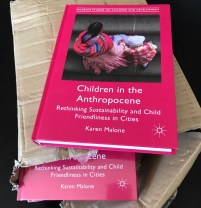
Malone, K. (2018) Children in the Anthropocene: Rethinking Sustainability and Child Friendliness in Cities, Palgrave Press, UK. http://www.palgrave.com/us/book/9781137430908
Malone, Karen, Truong, Son and Gray, Tonia (eds) (2017) Reimagining Sustainability in Precarious Times, London: Springer. https://link.springer.com/book/10.1007/978-981-10-2550-1
Latham, G., Blaise, M., Dole, S., Faulkner, J. and Malone, K. (2012) 2nd Edition Learning to Teach: New Times, New Practice, Oxford; Oxford University Press.
Malone, K. (2007) (ed) Child Space: An Anthropological Exploration of Young People’s Use of Space, Concept.
Robottom, I., Malone, K. and Walker, R. (2000) Case Studies in Environmental Education: Policy and Practice, Geelong: Deakin University Press.
McLeod, J., and Malone, K. (eds.) (2000) Researching Youth, Tasmania: Australian Youth Studies Clearinghouse.
Recent Book Chapters
Malone, K. (2023). Childhoodnature: Applying a sympoietic approach to child-outdoor-nature encounters, in Jan Činčera (Eds) Outdoor Environmental Education in the Contemporary World, Springer.
Malone, K. (2023). Indigenous Children’s Speculative Future Imaginaries of Place, Weathering and Ruination, in Bishop, K., and Dimoulias, K., (Eds) The Routledge Handbook of the Built Environments of Diverse Childhoods, Routledge.
Duhn, I., Malone, K., and Knight, L. (2022) Relational Mappings and Global Childhoods, in Yelland, N., Peters, L., Fairchild, N., Tesar, M., and Perez, M. (eds) Global Childhoods Handbook, Sage Publishers.
Cutter-Mackenzie-Knowles, A., Malone, K., Whitehouse, H., & Krasney, M. (2020). Childhoodnature and the Anthropocene: An Epoch of ‘Cenes’. In A Cutter-Mackenzie-Knowles, K Malone & E Barratt Hacking. (Ed). International Research Handbook on Childhoodnature – Assemblages of Childhood and Nature. The Netherlands: Springer. 10.1007/978-3-319-67286-1_35 ISSN 2197-1951
Cutter-Mackenzie-Knowles, K Malone & E Barratt Hacking. (2020). Childhoodnature an assemblage adventure, In A Cutter-Mackenzie-Knowles, K Malone & E Barratt Hacking. (Ed). International Research Handbook on Childhoodnature – Assemblages of Childhood and Nature. The Netherlands: Springer. 10.1007/978-3-319-67286-1_2
Malone, K. (2020). Re-turning Childhoodnature: A Diffractive Account of the Past Tracings of Childhoodnature as a Series of Theoretical Turns, in Cutter-Mackenzie A., Malone K., Barratt Hacking E. (eds) Research Handbook on Childhoodnature. Springer International Handbooks of Education. Springer, Cham. 10.1007/978-3-319-67286-1_4
Malone K. (2020). Children in the Anthropocene: How Are They Implicated? in Cutter-Mackenzie A., Malone K., Barratt Hacking E. (eds) Research Handbook on Childhoodnature. Springer International Handbooks of Education. Springer, Cham DOI: 10.1007/978-3-319-67286-1_36
Malone, K, Dunn, I and Tesar, M. (2020). Greedy Bags of Childhoodnature Theories, in Cutter-Mackenzie, A, Malone, K, Barratt, E (eds) Research Handbook on Childhoodnature. Springer International Handbooks of Education. Springer, Cham. 10.1007/978-3-319-67286-1_3
Malone, K. (2020) Uneasy assemblages of childearthbodies, in Janice Kroeger and Meyers, C. (eds) Children, Elders, Earth, Routledge.
Malone, K, Diaz-Diaz, C, and Semenec, P,. (2020) Interview with Karen Malone, Posthumanist and New Materialist Methodologies, Singapore, Springer.
Duhn, I., Malone, K., and Tesar, M. (2019), Introduction: Troubling the intersections of urban/nature/childhood in environmental education, In Duhn, I., Malone, K., and Tesar, M. (eds) Urban Nature and Childhoods, London, Routledge
Cutter-Mackenzie-Knowles, A., Logan, M., Khatun, F. & Malone, K. (2019). A Conceptual Cartography of Environmental Education. In Lees, J. E. Vinuales. Handbook of Comparative Environmental Law. Oxford: Oxford University Press.
Cutter-Mackenzie-Knowles, A., Malone, K., Whitehouse, H., & Krasney, M. (2019). Childhoodnature and the Anthropocene: An Epoch of ‘Cenes’. In A Cutter-Mackenzie-Knowles, K Malone & E Barratt Hacking. (Ed). International Research Handbook on Childhoodnature – Assemblages of Childhood and Nature. The Netherlands: Springer.
Cutter-Mackenzie-Knowles, K Malone & E Barratt Hacking. (2019). Childhoodnature an assemblage adventure, In A Cutter-Mackenzie-Knowles, K Malone & E Barratt Hacking. (Ed). International Research Handbook on Childhoodnature – Assemblages of Childhood and Nature. The Netherlands: Springer.
Malone, K. (2019) Uneasy assemblages of childearthbodies, in Janice Kroeger and Meyers, C. (eds) Children, Elders, Earth, Routledge.
Malone, K (2019) Re-turning Childhoodnature: A Diffractive Account of the Past Tracings of Childhoodnature as a Series of Theoretical Turns, in Cutter-Mackenzie A., Malone K., Barratt Hacking E. (eds) Research Handbook on Childhoodnature. Springer International Handbooks of Education. Springer, Cham.
Malone, K, Dunn, I and Tesar, M. (2018) Greedy Bags of Childhoodnature Theories, in Cutter-Mackenzie, A, Malone, K, Barratt, E (eds) In Cutter-Mackenzie A., Malone K., Barratt Hacking E. (eds) Research Handbook on Childhoodnature. Springer International Handbooks of Education. Springer, Cham.
Malone K. (2018) Children in the Anthropocene: How Are They Implicated? in Cutter-Mackenzie A., Malone K., Barratt Hacking E. (eds) Research Handbook on Childhoodnature. Springer International Handbooks of Education. Springer, Cham
Malone, K. (2018) Co-mingling kin: exploring histories of uneasy human-animal relations as sites for ecological posthumanist pedagogies, in Teresa Lloro-Bidart and Valerie Banschbach (eds) Animals in Environmental Education: Interdisciplinary Approaches to Curriculum and Pedagogy, Palgrave Publishers.
Malone, K. (2017), Grappling with data, in Koro-Ljungberg, M, Loytonen, T., and Tesar, M (eds) Disrupting data in qualitative inquiry: Entanglements with the post-critical and post-anthropocentric, Peter Lang, USA.
Malone, K. (2017) Ecological Posthumanist theorising: Grappling with Child-Dog-Bodies, in Malone, K., Truong, S,. and Gray, T (eds) Reimagining Sustainability in Precarious Times, Springer: UK.
Malone, K. and Truong, S. (2017) Sustainability, Education and Anthropocentric Precarity, in Malone, K., Truong, S,. and Gray, T (eds) Reimagining Sustainability in Precarious Times, Springer: UK.
Rudd, A., Malone, K and Barlett, M. (2017), Participatory Urban Planning, Kudryavtsev, A. and Krasny, M (eds) Urban Environmental Education Review, Cornell University Press.
Malone, Karen. (2017) Planning for a sustainable future through the Child Friendly Cities, Bishop, K, (Editor) Designing for Kids in the City: Beyond Playgrounds and Skate Parks, Routledge.
Malone, Karen (2016) Place, Peters, Michael (ed) Encyclopedia of Educational Philosophy and Theory,
Malone, Karen (2016) Children and Sustainability, Peters, Michael (ed) Encyclopedia of Educational Philosophy and Theory,
Malone, Karen (2016) Children’s Place Encounters: Place-Based Participatory Research to Design a Child- Friendly and Sustainable Urban Development. Skelton, T (Editor in Chief) Volume 8, Geographies of Children and Young People, Springer London.
Malone, Karen (2016) Child Friendly and Sustainable Cities: exploring children’s mobility, risk and agency at the global and local level, Skelton, T (Editor in Chief) Volume 12, Geographies of Children and Young People, Springer London.
Malone, K. (2016) “Dapto Dreaming” a place-based research and environmental education project supporting children to be active agents of environmental change, in Winograd, K. (ed) Education in Times of Environmental Crises: Teaching Children to be Agents of Change, Routledge.
Malone, K (2016) Posthumanist approaches to theorizing children’s human-nature relations, Nairn et al. (eds.), Space, Place and Environment, Geographies of Children and Young People Volume 3, DOI 10.1007/978-981-4585-90-3_14-1
Journal Articles
Malone, K. and Young, T. (2023) Making Kin: Exploring New Pedagogical Openings in Sustainability Education in Higher Education, Educational Philosophy and Theory Journal. Special Issue “Retheorising Environmental Sustainability Education in Anthropocene” DOI: 10.1080/00131857.2023.2225768 [Q1]
Malone. K. and Tran, C. (2023) Diffracting Child-Virus Multispecies Bodies: a Rethinking of Sustainability Education with East – West Philosophies, Educational Philosophy and Theory Journal. Special Issue “Retheorising Environmental Sustainability Education in Anthropocene” DOI: 10.1080/00131857.2022.2142554 [Q1]
Young, T. and Malone, K. (2023). Reconfiguring environmental sustainability education by exploring past/present/future pedagogical openings with pre-service teachers, Teaching in Higher Education, DOI: 10.1080/13562517.2023.2197112 [Q1]
Malone, K, and Crinall, S. (2023) Children as Worlding but not Only: holding space for unknowing and undoing, unfolding and ongoing, Children’s Geographies. DOI: 10.1080/14733285.2023.2219624 [Q1]
Malone, K. Young, T and Tran, C. (2023). Posthumanism and Environmental Education, Oxford Education Bibliographies, Oxford University Press.
Malone, K. and Young, T. (2023) Retheorising Environmental Sustainability Education in Anthropocene Educational Philosophy and Theory Journal. DOI: 10.1080/00131857.2022.2152327 [Q1]
Young, T, Crinall, S and Malone, K. (2022), Disruptions of post-qualitative research: Tensions and Openings, Qualitative Inquiry, 28 (3-4), 312-321, DOI: 10.1177/10778004211038255 [Q1]
Malone, K., (2020). Mapping making philosophy in education; Lines, knots and knotting. Australian Journal of Environmental Education, 36 (2), 97-104. [Q2]
Malone, K., Logan, M., Siegel, L., Regalado, J., & Wade-Leeuwen, B. (2020). Shimmering with Deborah Rose: Posthuman theory-making with feminist ecophilosophers and social ecologists. Australian Journal of Environmental Education, 36 (2), 129–145 [Q2]
Malone. K. (2020). Childhood ecologies in Covid-19: Episodic memories of leading and mothering, The First Years: Nga- Tau Tuatahi. New Zealand Journal of Infant and Toddler Education, 22 (2), 29-34.
Malone, K. (2019). Worlding with Kin: Diffracting Childfish Sensorial Ecological Encounters through Moving Image, Video Journal of Education and Pedagogies, 4, pp.69-80.
Malone, K. (2019). Walking-with children on blasted landscapes, Journal of Public Pedagogies, 4, pp. 155-164.
Malone, K and Moore, S.J., (2019). Sensing Ecologically through Kin and Stones, International Journal of Early Childhood Environmental Education, 7(1), p. 8-25.
Duhn, Iris, Malone, Karen and Tesar, Marek (2017), Troubling the intersections of urban/nature/childhood in environmental education, Environmental Education Researcher, 23, (10), p. 1357-1368. DOI: 10.1080/13504622.2017.1390884 [Q1]
Malone, Karen. (2016) Reconsidering children’s encounters with nature and place using posthumanism, Australian Journal of Environmental Education, 32(1), 1-15. [Q3]
Schoeppe, Stephanie., Tranter, Paul., Duncan, Mitch J., Curtis, , Carver, Alison., and Malone, Karen (2016) Australian children’s independent mobility levels: Secondary analyses of cross-sectional data between 1991-2012, Children’s Geographies, 14 (4), p.408-421. [Q1]
Malone, Karen, (2016) Theorizing a child-dog encounter in the slums of La Paz using posthumanistic approaches in order to disrupt universalisms in current ‘child in nature’ debates. Children’s Geographies. 14 Issue 4, p. 390-407. DOI: 10.1080/14733285.2015.1077369 [Q1]
Malone, K. (2015), Children’s Rights and the Crisis of Rapid Urbanization: Exploring the United Nations Post 2015 Sustainable Development Agenda and the potential role for UNICEF’s Child Friendly Cities Initiative. The International Journal of Children’s Rights, 23 p. 405-424. [Q2]
Malone, K (2013) Children, Urbanization and Sustainable Development, Conference proceedings 3rd International Child Friendly Cities Conference, Child-Rights Approach to Governance, Equity, Inclusion and Sustainability for children in the Asia Pacific Kathmandu Nepal, June 27-29 June, 2103. (http://childfriendlycities.org/news/events/)
Malone, K. A (2013) “The future lies in our hands”: children as researchers and environmental change agents in designing a child-friendly neighbourhood, Local Environment: The International Journal of Justice and Sustainability, 18:3, pp. 372-395. [Q1]
Malone, K. A. (2011) My Island Home: Theorising Childhood in the Cook Islands, The Asia Pacific Journal of Anthropology, 12: 5, pp.462: 477. [Q1]
Dowdell, K., Gray, T and Malone, K (2011) Nature and It’s Influence on Children’s Outdoor Play. Australian Journal of Outdoor Education, 15 (2), 24-35.
Malone, K. A (2011) Changing Global childhoods: the impact on children’s independent mobility, Global Studies of Childhood, Volume 1 Number 3, pp. 161-166.
Rudner, J and Malone, K. A (2011) Childhood in the Suburbs and the Australian Dream: how has it impacted children’s independent mobility? Global Studies of Childhood 1(3), pp. 207 – 225.
Malone, K. A and Rudner, J (2011) Global Perspectives on Children’s Independent Mobility: a socio-cultural comparisons and theoretical discussion on children’s lives in four countries in Asia and Africa, Global Studies of Childhood, 1 (3), pp. 243-259.
Malone, K. A. (2010). Freeing children to contribute: Building child-friendly cities in the Asia Pacific region, Childhood Matters, 115, pp. 20-25.
Malone, K. A. (2009). Designs for a Child Friendly Asia Pacific. Journal of Association for Children’s Environments, 5 (1), pp.15-17.
Malone, K. A. (2009). Designs for a child-friendly city. Curriculum Leadership, 7 (2), http://cmslive.curriculum.edu.au/leader/designs_for_a_child,26559.html
Tranter, P. & Malone, K. A. (2008). Out of bounds: insights from Australian children to support sustainable cities. Encounter: Education for Meaning and Social Justice, 21 (4), pp. 20-26.
Malone, K. A. & Hartung, C. (2008). Bursting the Bubble wrap: supporting research by children to create child-friendly cities. Journal of Association for Children’s Environments, 4 (1), pp. 13-15.
Marr, P. A. & Malone, K. A. (2008). Unpacking Global Education: An itinerary for pre-service teachers. In D. Webb (Eds.), SEAA Conference Proceedings, University of Newcastle, Newcastle 21-22 January 2008.
Malone, K. (2007) The Bubble-wrap generation: children growing up in walled gardens, Environmental Education Researcher, 13 (4), pp. 513-528. [Q1]
Marr, P and Malone, K (2007) What about me? Children as co-researchers, Australian Association for Research in Education Conference Fremantle, Perth, December 2007.
Malone, K (2006) Research by Children: Are we there yet? Keynote address and published paper Researching Children, Open Conference, 25th-28th June, University of East Anglia, Norwich UK, 2006
Malone, K. (2006) “Would you tell me, please, which way I ought to go from here?”: a journey in search of ESD Wonderland, Conference proceedings New Zealand Association for Environmental Education, University of Auckland, Auckland 22-25 January.
Chawla, L. Natasha Blanchet-Cohen, N. Cosco, N., Driskell, D., Kruger, J. Malone, K, Moore, R. Percy-Smith, B. (2005) Don’t Just Listen- Do Something! Lessons Learned about Governance from the Growing Up in Cities Project Children, Youth and Environments 15(2), http://www.colorado.edu/journals/cye/15_2/index.htm
Malone, K. & Tranter, P. (2005). “Hanging out in the school ground”: a reflective look at researching children’s environmental learning, (special school ground edition), Canadian Journal for Environmental Education, 10 (1), pp. 212 – 224
Malone, K (2005) Science Thinking Books: Children talking, thinking and drawing their way into science, Hong Kong Journal of Early Childhood, 4 (1), pp. 15 -20.
Malone, K. (2004) “Holding Environments”: Creating spaces to support children’s environmental learning in the 21st century, Australian Journal of Environmental Education, 20, pp. 53-66. [Q2]
Tranter, P. & Malone, K. (2004) Geographies of environmental learning: an exploration of children’s use of school grounds, Children Geographies, 2 (1). pp. 131-156. [Q1]
Gloria Latham, Julie Faulkner, Shelley Dole, Mindy Blaise, Karen Malone, Josephine Lang (2004), The Virtual Classroom as a Pedagogical Space in Preservice Teacher Education. Conference proceedings Australian Association for Research in Education, Melbourne December, 2004.
Mindy Blaise, Shelley Dole, Gloria Latham, Karen Malone, Julie Faulkner, Josephine Lang (2004) Reconstructing Reflective Journals in Teacher Education, Conference proceedings Australian Association for Research in Education, Melbourne December, 2004.
Malone, K (2004) Pacific Paradise or Postcolonial Nightmare? Children’s environmental experiences of growing up in PNG, Melanesian and Pacific Studies Centre, University of Papua New Guinea, Refereed conference proceedings, 22-24th June, 2004.
Gloria Latham, Mindy Blaise, Karen Malone, Shelley Dole, Julie Faulkner, Josephine Lang (2004) New learning in teacher education programs, Published conference proceedings Australian Teacher Education Association, 7-10 July, Bathurst, NSW.
Butcher, J, Howard, P, Labone, E, Bailey, M, Groundwater-Smith, S, McFadden, M, Mc Meniman, M, Malone, K and Martinez, K. (2003) Teacher Education, Community Service Learning and Student Efficacy for Community Engagement, Asia Pacific Journal of Teacher Education, 31 (2), July, pp. 109 -124. [Q1]
Malone, K and Tranter, P. (2003) School Grounds as Sites for Learning: making the most of environmental opportunities, Environmental Education Researcher, 9, (3), p. 283 – 303. [Q1]
Malone, K. and Tranter, P. (2003) Children’s environmental Learning and Use, Design and Management of School Grounds, Children, Youth and Environments, 13 (2) http://www.colorado.edu/journals/cye/13_2/Malone_Tranter/ChildrensEnvLearning.htm
Tranter, P. and Malone, K. (2003) Out of Bounds: insights from children to support a cultural shift towards sustainable and child-friendly cities, State of Australian Cities National Conference, University of Western Sydney, Parramatta, 3-5 December, 2003. Refereed proceedings available online: www.uws.edu.au/about/acadorg/caess/uf/conference.
Malone, K. (2003) Pacific Paradise or Postcolonial Nightmare? Children’s environmental experiences of growing up on small island nations in the Pacific Ocean. Paper presented at the 15Th ICAES conference, Florence, 13-16 July 2003
Malone, K. (2002) Streetlife: Youth, culture and competing uses of public space, Environment and Urbanization, 14 (2), pp. 157-168. [Q1]
Malone, K. (2002) “I want the world to be a nice place to live”: Neighbourhood Quality from a Child’s Perspective, proceedings from Children and youth environments Conference, Children’s Issues centre, Dunedin, June.
Malone, K. (2001) Children, Youth and Sustainable Cities (special edition editorial), Local Environment, 6 (1), pp. 5-12. [Q1]
Malone, K. (2000) Where do the children play? The tale of a research project spanning twenty-five years. Conference proceedings PaPER98 conference, ‘A celebration of environment-behaviour research’ Faculty of Architecture, University of Sydney, December 3-6, 1998. pp. 71-82
Malone, K. (1999) Reclaiming silenced voices through practices of education and environmental popular knowledge production. Canadian Journal of Environmental Education, 4, Summer, pp. 231-242.
Malone, K (1999) Growing Up In Cities as a model of participatory planning and ‘place-making’ with young people, Youth Studies Australia, 18 (2), pp. 17-23.
Malone, K (1999) Environmental education researchers as environmental activists, Environmental Education Research, 5 (2). pp. 163-177 [Q1]
Malone, K and Hasluck, L. (1998) ‘Geographies of Exclusion’: Young people perception’s and use of public space, Family Matters, 49 Autumn, pp. 20-26. [Q4]
Malone, K. (1998) About the Growing Up in Cities Project, Family Matters, 49 Autumn, pp. 22-23. [Q4]
Malone, K. (1995) Celebrating our subjectivity: research as lived experience, South African Journal of Environmental Education, 14, pp 10-14
Research Reports
Malone, Karen, Moore, Sarah Jane and Ward, K (2019) Children’s Bodies Sensing Ecologically: a study of pre-language children’s ecological encounters, Western Sydney University Research Report.
Malone, Karen and Waite, Sue (2016) Student Outcomes and Natural Schooling: Pathways form Evidence to Impact Report 2016, Plymouth: Plymouth.
Malone, Karen (2016) Albanian Child Friendly Cities Action Plan 2016-2018, University of Western Sydney.
Malone, Karen (2016) Albanian Child Friendly Cities Framework 2016-2018, University of Western Sydney.
Malone, K, and Somerville, M. (2016) Education for Sustainable Development Report: Contribution of ESD to Quality Education in Australian Schools, Centre for Educational Research, Western Sydney University.
Malone, Karen, Birrell, Carol, Boyle, Ian and Gray, Tonia (2015) Wild Nature Play: Researching OOSH in the Bush, Centre for Educational Research, University of Western Sydney.
Malone, K. (2015) Researching with children in four Kazakh cities to support child friendliness recognition, University of Western Sydney, Bankstown, NSW, Australia.
Malone, K. (2015) Child Friendly Cities: Researching with children in Aktau, University of Western Sydney.
Malone, K. (2015) Child Friendly Cities: Researching with children in Astana, University of Western Sydney.
Malone, K. (2015) Child Friendly Cities: Researching with children in Kyzylorda, University of Western Sydney.
Malone, K. (2015) Child Friendly Cities: Researching with children in Semey, University of Western Sydney.
Malone, K (2014) Child Friendly Kazakhstan: National Child Friendly City and Recognition Model, UNICEF Kazakhstan and UWS, Sydney NSW, Australia.
Malone, K., Dimoulias, K., Truong, S., and Ward, K. (2014) Researching Children’s Designs for a Child Friendly Play Space at Rouse Hill Town Centre, Centre for Educational Research, University of Western Sydney.
Malone, K (2013) Child Friendly Bolivia: Researching with Children in La Paz, Bolivia, Centre for Educational Research, UWS, Sydney NSW, Australia ISBN 978-1-74108-301-9
Malone K and Malone, M (2013) A Portrait of La Paz: Shot by its Children, UWS, Sydney NSW Australia
Malone, K (2011) Child Friendly Kazakhstan: Designing and implementing a national child friendly cities recognition and accreditation program, UNICEF Kazakhstan and UWS, Sydney NSW, Australia.
K. (2011) Dreaming and designing a child-friendly neighbourhood for Brooks Reach, Dapto: Child Friendly Consultation and Children’s Research report, University of Wollongong, Wollongong, NSW, Australia.
Malone, K (2011) Dapto Dreaming: a child friendly report about Dapto, University of Wollongong, Wollongong, NSW, Australia.
Social Media Links
Facebook: Children in the Anthropocene https://www.facebook.com/ChildreninAnthropocene/
Online Institute for Interdisciplinary Research into the Anthropocene https://iiraorg.com/
 Children in the Anthropocene